Tuesday, May 8, 2012

trip to Quito

My final weekend in Quito was a great time of reconnecting with some of the first group of residents/interns and doing some touristy stuff with them before I left.  I had a wonderful dinner with Marita and her family, Anita and her brother Fernando, and Gaby and her husband and son on Friday night in a beautiful part of the downtown called the Ronda.  It is in a neighborhood of restaurants and shops in the old colonial style buildings with flowerpots everywhere and live music in many of the restaurants, including ours. 

Anita graciously hosted me despite having to work at 5 am on Saturday, and her parents fed me breakfast in the morning (after meeting me for the first time since we had gotten in around 1:30 am after a late dinner the night before.  Then I headed out with Gaby and her husband Luis (and later her son Gabriel and her parents, sister, and grandmother) to La Mitad del Mundo, the traditional (although slightly off) site of the equator in Ecuador. 


I loved the afternoon festivities of group after group of various folk dances from different parts of the country.  They included different brightly colored outfits and everyone seemed to enjoy watching, including the mostly Ecuadorian audience.  I got a little more involved in the enjoyment than I planned when one of the dancers hauled me into the dance at the end when they went around trying to get other people to join them!


This dance was from Esmeraldas, a mostly Afro-Ecuadorian province in the north.
 
 
A good reminder of how much dancing is a part of Latin culture for old and young alike.  These little girls and their little boy partners enjoyed the dance and participated just as much as the older dancers!

At lunch afterwards with Gaby's family, I even got to try cuy, or guinea pig, an Ecuadorian specialty. 

After the lovely day, we met up with Anita who had finished work and went to the artisanry market in Quito, where I got some earrings for my sisters.  Then I returned to Anita's house and hung out with her family until it was time for me to go to the airport.  I was blessed and touched by the hospitality of my friends, despite our short acquaintance.  They welcomed me into their families and homes and lives with no self-consciousness and no hint of the effort and time that hosting me cost them.  I am grateful for the grace they showed me.  It was a wonderful ending to my time in Ecuador.

Monday, April 30, 2012

viaje a Baños (trip to Baños)

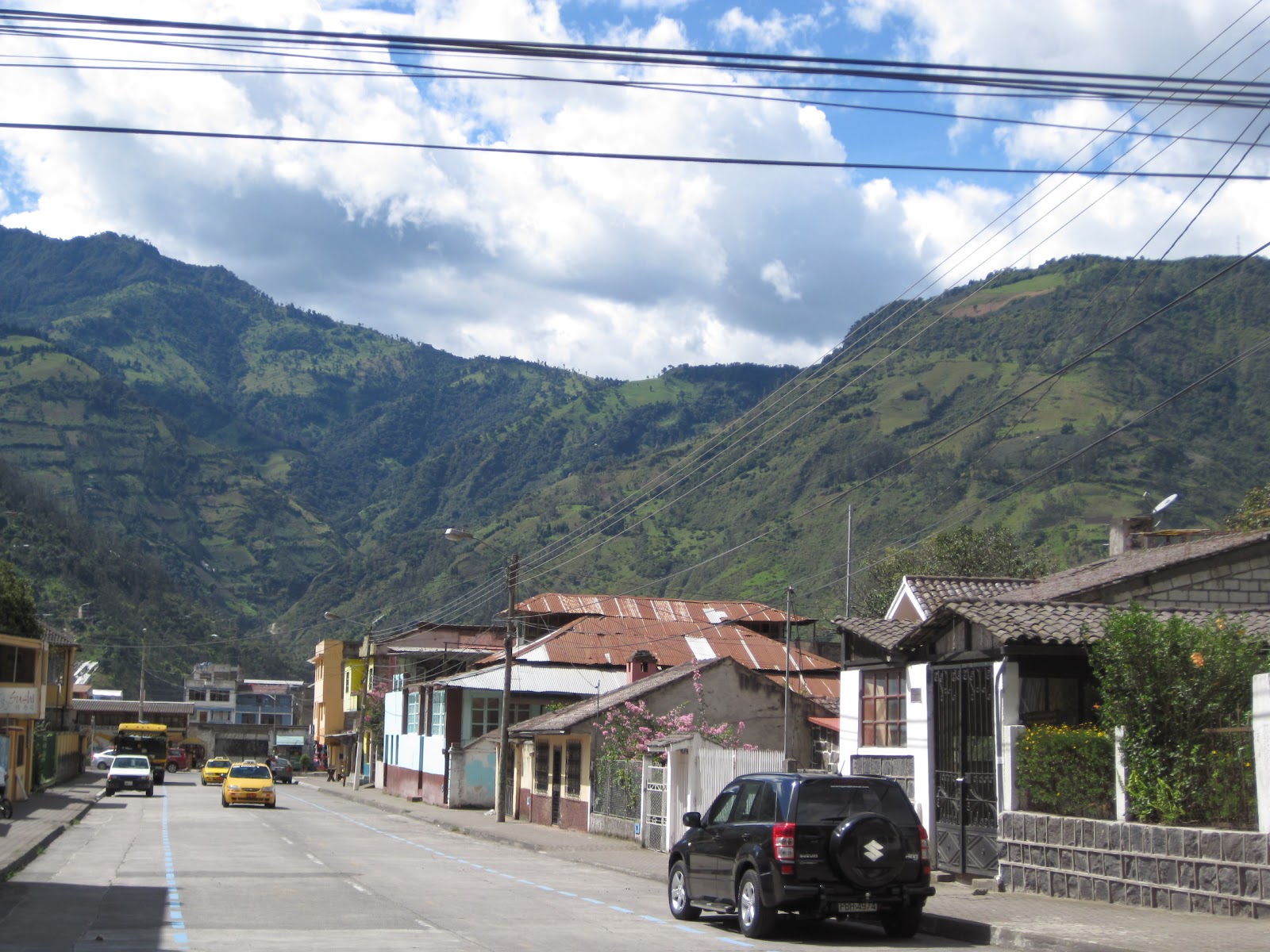
The past two weekends I have gone to nearby Baños on my free weekends.  It is an hour plus trip on windy mountain roads, happily reinforced by guardrails and two-lane the whole way, although drivers do still pass on the road (but not on corners nearly as much as I expected).  It is a lovely trip through the unending green of the mountains with clouds visible hanging at an almost-touchable distance just above one's head.  Here are some of my pictures with narrative. 

This is from the first weekend trip with some residents with me trying to capture the way the wispy clouds hang on the mountainsides.

 
Landslides, or derrumbes, are always an issue in the mountains, although much less so with this road than the old one.  I think this was actually blasted away for the road, based on the marks in the dirt, but it reminded me of the possibility, especially with as much rain as they get here. 

Baños is known for its Virgen de Agua Santa, and there is a large and beautiful church whose walls are covered with paintings of stories where the Virgen saved people falling from bridges or whose house should have burned or during one of the volcanic eruptions.  This is the waterfall that overlooks the town.

Marking its location as a tourist hot spot, the busy bus depot is surrounded by many stalls of fruit and caña (sugar cane).

 
The lovely green mountains sweep into deep valleys invariably with a river at the bottom.

  
This is the plateau on which Baños is situated, overlooked by the Volcano Tunguraha, whose activity causes the hot springs and baths that give the city its name and parts of its attraction.  If you look closely, there are two small waterfalls on the right falling off the plateau.

It's just beautiful.
One of the many fruit and candy (taffy) stalls, complete with stacks of caña.  I managed also accidentally to get the typically dressed indigenous older man in the picture, which made me very happy.

Ha.  Pork, anyone?


A typical view of the mountains surrounding Baños' plateau.

The mountains in the background, the large church to the Virgen in the mid ground, and gorgeous bougainvillea in the foreground.

A map of Baños' plateau and the roads in and out and the volcano that overlooks it.  The windy road to the top left of the map goes up to Shell, second-to-last destination on the map.

The volcano itself.


One of the cascadas (waterfalls) on the Ruta de las Cascadas.  This one is called the Novios (boyfriend/girlfriend).  It used to be one falls alone, the one on the right and was called Manto de la Novia (the bride's veil), but after a volcanic eruption, the river divided higher up, and now the left one has been added to make the pair.

I think this one shares a name with the large dam and hydroelectric power plant, Agoyán.  I'm not sure which got named first...

We took a little cable car over to close to the falls.  I was glad I'm not acrophobic!


This little guy is called something related to snakes, I think Cascada de Culebra.

A view of the old road, which the older missionary doctor I was traveling with told me used to be open once a week due to landslides and muddy conditions.  It wasn't paved when he started here, and it drops off steeply to the right.  It didn't use to have that guard thing, either, and it was two-way, one-and-a-half lanes.  The road passes under a little waterfall off the rocks, which the doctor told me they used to call the carwash.  :)

This is one of later falls on the Ruta called Pailón del Diablo, or the Devil's Bowl-whirlpool, for the way the water crashes into that rock formation before flowing out at the bottom.

We caught the bus after a literally one-minute wait along the highway from the halfway point between Shell and Baños where the tour dropped us off and arrived back in Shell to a lovely sunset.  I just don't tire of the mountains here, so different from at home.  I do wish the clouds cleared up a bit more and I could see the stars (I think I could see both the Southern Cross and the Big Dipper the one night it was clear), but it makes for some lovely views.

Saturday, April 28, 2012

food (that is, fruit)

Ecuador has several foods for which it is known.  Guinea pig, or cuy, is one, but I haven't tried that one yet.  It isn't as common here in the Oriente (eastern part of the country).  Mariscos, or seafood, are common on the costa (coast).  Some foods, such as bananas and sometimes strawberries and the Costa Rican fruit I knew as mamón chino, go by different names here (guineo - bananas, frutilla - strawberries, mamones - achotillo here, lychee to my Asian friends in med school, rambutan in Wikipedia). 

 Mamones, or achotillo, or lychee.

I did get to out with some of the residents to nearby Puyo to try volquetero.  From what I can tell, it is sort of like a poor man's ceviche, made from a mix of chocho (a bean-like fruit/seed), maiz tostado (toasted corn), chifles (dried banana chips), tuna, and a salad of cebolla (onion) and tomate (tomato).  It was great!  I also got to try encebollado at a special breakfast at work, a traditional breakfast food, which also includes chifles, fish, tostados, yucca, tomato, and ají.

This is pretty much what our volquetero looked like, including the chunk of tuna from a can on top! 

Most of the other foods I have tried have been fruits.  Many are made into jugos (juices) that I drink at each lunch I buy:  frutilla/fresa (strawberry), mora (raspberry), tomate de arbol (tree tomato), guayaba (guava), guanabana, naranjilla (little orange), granadilla, etc.  Some of the ones I got at the store as well as others are pictured below. 

Pepino dulce, or sweet cucumber.  It was a fairly mild, bland, crisp fruit.  The name is appropriate.
 
Babaco, which is currently sitting in my fridge as I wait for it to turn more yellow, is supposed to be good made into a juice.  There is a blender in my apartment, so I plan on figuring out how to use it.  (We don't have one at my home in Lancaster, and I've never done much with one.  I think you just push buttons.  How hard can it be?)  :)

 
 Maracuyá, or passionfruit, is the yellow fruit which has a tart inside usually made into juice.  A patient gave me a whole bag of tomate de arbol, the red fruit above, so I need to make that into juice, too.

                              
I don't remember what this one is called.  I think I'm supposed to just cut it up and eat it.  

 
This is granadilla, which has sweet pulp surrounding black seeds on the inside, all of which you eat (although not the shell.

Not pictured are the papaya I recently bought at a small stand here in Shell and the lemons (called that although they're more like a cross between a lemon and a lime) we pick off a tree outside the residents' house to squeeze onto fish, avocado, and many other things.  Most Ecuadorian main dishes are accompanied by ahí, the national version of hot sauce that I think also has garlic and onions in it.  It's not very hot, at least in my limited experience, but does add a nice additional flavor.  Patacones (fried green plantains) seem to be a common side in restaurants, but platanos maduros (fried ripe plantains) are less common although often available upon request.  Yucca is common, both as a side and in soups.  Soups are very common - every lunch I buy has a soup on the side.  I have not found a lot of vegetables besides tomatoes, and I am very much looking forward to getting home, starting my garden, and eating my usual half-plateful of vegetables each night for dinner.  That said, I will miss trying new things, drinking freshly made jugos, and how cheaply I can buy fresh fruit here.

Friday, April 27, 2012

pacientes 3

I may have had my first Ecuadorian patient with TB last week.  She was a 74-year-old woman with a 6-month history of edema (swelling) in her legs that had worsened over the past week with associated shortness of breath.  It sounded like a classic picture of heart failure.  Her lungs sounded surprisingly clear, however, and she didn't have the cardiomegaly (enlarged heart) on X-ray or distended neck veins typical of congestive heart failure, although she did have impressive edema to her hips.  What she did have on the X-ray, however, fit more with her history of oral candidiasis with some odynophagia (pain with swallowing) and progressive weight loss:  a circular lesion with an air-fluid level suspicious for active tuberculosis (TB).  I sent her for AFB smears, as Ecuador requires two, and an HIV test, although she isn't coughing up blood and doesn't have night sweats (which with weight loss are the classic triad of TB), so I'm not completely sure of the diagnosis.  She sure has something going on in that left lung, though (see below).


This past week we admitted what is I think our third or fourth patient with snake bite in my time here.  This poor fellow had been treated in a different hospital a month ago, and the management had been suboptimal (especially not receiving antiofídico, antivenom, when he should have).  He had gone to a second hospital but left against medical advice when they recommended amputation of his right leg below the knee.  He went home and his wife put herbal dressings on his leg for the next three weeks until they decided to come here.  His entire anterior (front) leg was necrotic, and there is a 6-inch space between the skin on one side and on the other where there used to be muscle and skin.  Both leg bones are exposed, and on the X-ray below it looks like both have osteomyelitis.  He was resistant initially to the idea of amputation, but the surgeons have explained to him that it may end up being losing his leg or slowly losing his life from spreading infection.  He did have a below-the-knee amputation then towards the end of last week and seems to be doing fairly well.  Compare the moth-eaten appearance of his fibula (smaller bone) X-ray and the darkened out, infected marrow of his tibia (larger bone) with the normal image below.


I had another interesting patient in clinic this week, a 15 year old girl with 2-day history of epigastric and right upper quadrant pain, nausea, and vomiting.  Her exam had some mild epigastric tenderness and normal vital signs, and she said her vomiting was already getting somewhat better.  I figured it was a gastritis, probably from a viral infection, but they were worried about her having reflux, so I gave them a prescription for Tylenol and ranitidine and asked her to come back if she wasn't feeling better.  She came back three days later complaining of yellow eyes.  I did note some mild scleral icterus, although I had thought that was her normal pigmentation when seeing her at the first appointment, but she and her father agreed this was new, so I ordered blood tests for liver functions, including bilirubin (the cause of yellow coloring of eyes/skin).  To my surprise, she had not only mild hyperbilirubinemia (2.7) but also elevated transaminases (AST 200s, ALT 600s) and an elevated alkaline phosphatase (~AP 250).  I ordered an eco(sonografia) (ultrasound) and acute hepatitis panel.  She didn't come back for follow up today, so I don't know the answer (and I'm not sure how long hep A IgM takes here anyway), but it seems she may be my first patient with hepatitis A.  Either that, or she's the youngest patient I've seen with symptomatic gallstones!  Hepatitis A is usually self-limited and she is clinically already getting better, so she will probably be fine. 

cultura (culture)

http://www.perhapstodaycamp.com/contact-us

 I was interested before leaving for Ecuador to see how this expression of Latin culture would differ from my previous experiences in Honduras and Costa Rica.  Would South America hold different cultural traditions?  On the edge of the Amazon in the Oriente, would I encounter more indigenous people with their own cultural traditions.  Other than herbal remedies I've never heard of (e.g. cinnamon water to induce labor) and an occasional reference to believing in "both sides" (i.e. medicine and herbal remedies or sometimes spiritual causes of illness bordering on animism) or performing a limpieza (cleaning - done by a shaman for illness), however, much of what I've encountered has had much in common with my previous experiences. 

I have always enjoyed the affectionate nature of Latin culture.  In my month rotation in medical school, I remember struggling in India with the inability to touch people in public in a way that wasn't necessary for the physical exam.  I realized while I was there that I normally touch people informally ALL THE TIME.  My family is demonstrative, and I am also personally very much that way.

http://news.bbc.co.uk/2/hi/7040259.stm?lsm

So, here, I love the air kisses, cheek-to-cheek (as above), that I get from everyone on the resident/intern team and some of the nurses, too, when we encounter each other for the first time in the morning as we make our way around on rounds.  I love the easy hugs with the female residents/interns and the way I don't have to be afraid to pat children on the head or touch a patient's shoulder or knee.  I love the fact that I can grab a laboring patient's hand in a contraction and know she will mostly likely welcome the touch.  Yes, fellow LGH residents, you can make fun of me for wanting to comfort laboring patients with touch (cf. last year's Roast Night), but touch is a huge part of who I am; you know you enjoy my hugs, too, and it comes as a package! 

I also am reminded often of the importance of hellos and goodbyes in Latin culture.  The air kiss greeting is part of it, but even if you don't greet that way, you do always greet people.  You say hello to people in passing and buenos dias to the nurses in the hall on the way to a patient's room.  When walking into a meeting, even if late (although then it's whispered), you greet people with the greeting appropriate for time of day (buenos dias, buenas tardes, buenas noches). 

Goodbyes are also important.  The residents that have left have made a point of saying goodbye, usually in person, and expressing their appreciation/respect/affection as the situation makes appropriate.  They have also routinely given short speeches in morning report on their last day or so.  This might happen after an extended stay at another location in the States but much less commonly in a professional setting where it is expected that you rotate in and out routinely.  I have yet to give such a speech on a rotation to another specialty (e.g. gynecology, ENT, ophthalmology, surgery, etc.) even when I did feel much appreciation for the rotation, evidence of the ways our cultural expectations of despedidas (goodbyes) are different.

Time is dealt with differently here, as in much of the rest of the developing world (and even in parts of the developed world).  Something that someone tells me will happen ahora (now) or ahorita (right now) may not happen for another half hour or hour.  Both seem to be translated more to "in a little while."  It makes it hard to communicate to patients that yes, I do really want them to get that blood test right now if possible (ahora mismo has become my attempt at communicating this) rather than tomorrow or next week.  Even ya (already) seems to take on more of a "soon" translation in some contexts.  On the other hand, patients are extremely patient waiting for their turn to be seen (no advance appointments) and then waiting for their test results that help to determine their diagnosis and treatments, for which I am grateful.

Although for the most part I have enjoyed Latin culture, there are also cultural things that are not as much fun, the primary one being gender expectations.  I have been pleased to find that I have experienced almost no treatment that seems to differ because of my own gender, unlike some of my previous experiences.  Even the piropos (catcalls) so common to a gringa walking anywhere in Costa Rica are rare here.  Nurses listen to me (including the one male one I have met), and our male intern treats me with respect.  Patients also seem to listen to me, regardless of whether they are male or female.

However, I have now encountered two fourteen-year-olds pregnant by a much older man.  This is illegal here, and I think legal procedures were followed in both cases, but it does still point out the ways in which women can be treated differently.  I see teen moms routinely in my practice in the States - less commonly young teens, but their boyfriends are usually also in their teens, not their 20s, 30s, or 40s. 

Another evidence of differing expectations of men and women is the way in which some of my female patients will bring a husband, brother, or uncle along to their appointment who speaks for them.  It can make for interesting history-taking when I'm not sure which questions I can ask in front of the relative and not sure whether their answers are actually the true history or just what they think is happening.  It is further complicated by the fact that these are often indigenous women whose Spanish level of understanding is uncertain, so it's not clear to me what the reasons for the spokesperson are - linguistic or cultural or both. 

Overall, however, my experience of Ecuadorian culture has been very positive.  I've enjoyed trying new foods (although I have yet to try cuy, Ecuadorian specialty of guinea pig), greeting with air kisses, saying goodbye well, and generally feeling welcomed to an emotionally warm environment.  I will have to see how much I've learned of the culture when I have my own chance at despedidas next week.  I can't believe I have only a week left!  I will miss the interesting cases and regular use of Spanish, but I am also looking forward to seeing family and friends again regularly.  And it won't take me an hour to walk to the grocery store for fruit like it did tonight (since I got lost in the dark on the way back), although then again the avocado that is now soaking in disinfectant solution in my sink wouldn't cost me $0.35 and five apples $1 and five bananas $0.50 in the States, either.  :)