Wednesday, January 11, 2012

stories 3

(see previous posts for 1 and 2)

from 11/2011:

I cried at work today.  I was working on the discharge of a 45-year-old woman admitted with intractable nausea and vomiting who was found during the admission to have brain metastases (spread) with a lung cancer as the primary tumor (origin).  She was talking about how she had hoped to go back to school to show her kids that you can do anything you dream of if you work hard enough for it.  She spoke of going back to work to provide for her family, including her youngest child who is eight years old.  I thought silently of how with her advanced disease I was pretty sure she won't make it to her 9-year-old's elementary graduation, let alone his high school, short of a miracle.  But I didn't say that.  Instead, I said, Take lots of pictures.  Work on spending as much time as you can in the short term with family as you learn more about and adjust to your new diagnosis, as you figure out what is going to be realistic in the days and weeks ahead.  She nodded.  Coming out of the room, I stood at the chart to write up the discharge orders and tried to hold myself together as I thought about her situation.  Instead, the tears slipped out as I silently grieved her losses - dreams, plans, time with family - until the nurse came up to make sure I didn't need anything further, and I wiped my eyes and wrote the orders for her to go home.

As the second year on ward, I see patients of our residents and faculty who are admitted to other services who need "medical management" for which we follow them while they are in the hospital.  Usually this means controlling their blood pressure or blood sugars, but it meant a lot more for one 25 year old woman for whom we were consulted to help deal with her anxiety and depression.  I stopped by to see her after rounds, so I had more time than the usual half-frenetic rush through the assigned patients before rounds.  I spent the next 1.5 hours of a thankfully slow day hearing her tragic history of abuse as a child; rape as a teenager; and physical, emotional, and sexual abuse by her first husband.  She now deals with so much anxiety that she literally can't even get out the front door to go see her mother down the street, her only real source of support, without first fortifying herself with anxiety medicines. 

"I have no friends," she said.  "I know people say that they have no one, but they always have someone.  I don't.  I have no one."  And I believe her as she recounts her story of being imprisoned in her own house by the wounds of her past experiences, trapped in unhealthy patterns and relationships.  I sat there on the foot of her bed and patted her foot as she cried in despair, and I prayed.  Her emptiness reminded me of an article I read a few years back on having nothing and emptiness and how God can work with that.  So I prayed and I pray that like the widow in 2 Kings 4 with her empty jars that this woman would come to the place of giving her emptiness to the One who can fill it to overflowing.  I have nothing better to offer.

Another patient I saw recently is a 35 year old female who told me in the course of her appointment about her home situation.  She wants out of her relationship with her husband who is having a long-term affair but feels trapped since due to her own health problems she has no way to provide for their six children.  She tells me about how she knew about her husband's girlfriend even before she became pregnant with their youngest child, and I wonder what she sees when she looks at herself in the mirror.  My heart longs for more for her - she is worth so much more - and I could hear the longing as she told her story, too.  But she can't see a way out, a way to live differently. 
 

So often when I am faced with patients' pain, I wish I were artistically gifted or somehow able to use my word to paint a different picture for them.  I want to show them another way of living, a way that life can be full of meaning and substance and, yes, even joy.  It is a different way of envisioning what it means to be human and what their lives are meant for - so much more than infidelity, abuse, and broken dreams.  They and you and I were made for relationships characterized by love and faithfulness, for learning to move past conflict to forgiveness and past broken pasts to restoration, for trusting the Dreamer's visions for us even when it means opening our hands to let the pieces of our plans fall through our fingers.  It is my hope and prayer that in my life and actions and sometimes even in words I can communicate to the broken people around me a new vision, a tapestry of what life can be, one aglow with the light and love of the One who makes our lives worthwhile, tinged at the edges with hope, and woven through with growing, stabilizing strands of healing.
These pictures by local Lancaster artist Liz Hess were done to portray the Exodus story for an African context, bearing witness to the truth of the story for all peoples.  The sense of release from oppression and joyous abandon in coming home that they so clearly portray is the same feeling I long to be present in the lives with which I come in contact.

Friday, October 14, 2011

life. breath. breathe.

Life is fragile.  Nowhere, perhaps, is that more apparent than obstetrics.  We so closely monitor these tiny lives dependent on their mother from months before viability up to and after delivery where we marvel at tiny fingers and toes complete with nails, the rosebud mouth, the blinking eyes, the soft spot. 


I'm on nursery this month, and I've seen a lot of newborns.  I also hear the OB signout in the morning since knowing what is going on with laboring moms will mean I know what to look for in the babies.  We've had a rash of high-risk, sad cases, though, and the fact that I never see the moms I hear about in signout reinforces my feeling of helplessness in the face of the tragedy down the hallway and yet completely out of my reach even to comfort. 

Perhaps the most dramatic example was a patient that came in with headaches and high blood pressure.  She didn't know she was pregnant despite being about 20 weeks and carrying (surprise!) twins.  Her severe and worsening preeclampsia, however, meant that it was a choice between losing three lives and losing two.  So a C-section was performed, and mom was closely monitored afterwards for her dangerously high blood pressures and risk of seizures, liver damage, and kidney damage.  Her babies died two hours after birth, unable to survive outside the womb at such severe prematurity.  I can't imagine the rollercoaster of emotions she has been on - feeling sick to discovering she is pregnant to learning she will lose the babies to watching the babies die to dangerously ill herself.  It makes me remember, too, the 19-week infant I held in my hands and watched die after a mother miscarried in Zambia. 

Another patient came in having broken her water ("ruptured membranes," as we say) at 20 weeks, nearly a month before viability when her baby could survive outside the womb.  She is at risk for infections without the membranes to keep bacteria out of the uterus, and the baby is at risk for separation of the placenta from the uterus without the fluid to keep it pushed up against and keep the uterus inflated, so to speak.  Her cervix is partially dilated, and the ultrasound showed the baby's feet moving in and out of the cervix with movements.  So close.  So close to life.  So close to death.  A few more weeks, and he or she might have a chance.  She was offered the possibility of delivery now since she has less than 1-3% chance of reaching 24 weeks without spontaneously delivering or getting an infection, but she chose to wait.  So here she is in the hospital, waiting. 

A similar patient who broke her water at 32 weeks waited for a week and a half before starting labor spontaneously and still ended up with a C-section when the baby wasn't doing well.  Her baby is still in the NICU a few weeks later.  She comes in to see him and is attempting to breastfeed.

But it's not just large things, dramatic cases that tear at my heart when I hear the details.  It's little things, too.  A baby's hearing screen comes up abnormal, and I feel for the parent who suddenly faces the possibility of life with a disabled child.  The baby looks perfect, but so much of this whole parenting and doctoring thing is beyond what we can see and control.  (A repeat hearing test ended up being normal, so fears were alleviated this time.)  Another infant has a low temperature overnight, prompting a workup for infection.  Again, the baby looks fine, has been feeding well and is active and vigorous, but I worry.  Am I missing something?  The stakes are so high.  These little lives are so fragile, and I know from the stories that things can go downhill quickly.

There are good experiences, too.  I went in a C-section and got to suction the (crying - yay! never are we so happy to hear a crying baby as at delivery) baby and learned to remove the placenta.  I am doing circumcisions under supervision and feeling more comfortable doing this relatively simple procedure and feeling happy with the results.  One of our babies was crying in the nursery one time when I was there waiting for something.  I picked him up, and he instantly stopped crying.  Gratifying - but again a reminder of how dependent these tiny people are on us older ones. 

The Bible connects the idea of life and breath, starting way back in Genesis when God breathes his breath into us, the breath of life, and humankind lives first in Adam and then also in Eve.  The promised new life as the people of God in the New Testament is also connected with breath, with God's Breath, his Spirit (same word in Greek pneuma and Hebrew ruah).  It makes sense; the last thing you see someone do when they die (naturally) is to breathe out. 


It reminds me of another image, that of vapor.  In Ecclesiastes, the writer reports that life is "meaningless."  I remember learning in my college Old Testament class that the word translated "meaningless" is hevel.  This is a word used to describe vapors, such as the early morning fog that would cover Jerusalem that would disappear nearly before the eyes of those who lived there as the sun rose.  As such, it communicates transience, the ephemeral nature of life. 

But the word has another meaning.  It is also used of breath, this invisible movement of air that enables us to live our lives, to laugh, to cry, to speak, to love, to worship.  The truth, I think - and what I am sensing in the vulnerable small lives I hold in my hands each morning as I round - is in this tension.  Life is temporary and fragile and yet it is beautiful and meaningful, full of significance and closer to its end than we like to think, as close as your next breath or mine.  I am relieved to remember that the balance is not in my faulty hands but in the love-marked hands on which our names are engraved so that we know he will never forget us.

                                      morning mist in modern-day Jerusalem

Monday, September 19, 2011

lessons from a relationship

I recently began a new relationship.  As is a new relationship's wont, it has been much on my mind.  This post goes through some of the things I have reflected upon as we have moved through the initial weeks of getting to know one another, particularly as it relates to the faith relationship I have with God.

I am struck by how much of the relationship itself consists in waiting.  We date because we don't know whether this will work out in the end, so we're waiting on a final verdict from one or both of us on the relationship itself.  Traditional in some ways at least, I (usually) wait for him to call.  We wait for the next step in the relationship itself as we gradually get to know each other better and so move to different levels of sharing.  But don't get me wrong.  Despite all the waiting inherent in this process, I am definitely enjoying the process itself!  It's just that it has struck me repeatedly that a relationship is just this:  something already but still a process of becoming what it will be.

Waiting in the context of a relationship recalls to mind the already/not yet tension present in the way Scripture talks about the Kingdom of God and Jesus' present reign on earth.  In some ways, it is already here, changing lives, working powerfully in this world, but in other, significant and substantive ways we still wait for the already-won Kingdom to be made manifest in our lives and this world.  We wait for the fuller, deeper thing even while we enjoy the very good thing we already have and glimpses in what we have of what is to come.  In this hurting yet wonder-full world and my fun yet becoming relationship, we wait, in hope.

I have been struck as well by the vulnerability that arises in me through this relationship.  I am used to being what I have been for most of my adult life:  basically an independent person.  Instead, suddenly my whole day's outlook can be changed dramatically by this single other person - whether he calls or not, what he says in an email, an unexpected letter, etc.  Just thinking of him brings a smile to my face, and my friends' teasing easily makes me blush.

So far the vulnerability has brought all good things; the cloud of euphoria that accompanies the early phase of a relationship makes me a very happy person!  But I know the power is there as well for one of us to hurt or disappoint the other, for careless words to wound, for lack of contact to inspire a loneliness I wouldn't have felt so keenly a few months ago.  It's a power that's scary to acknowledge in myself as well since both of our (not just mine) investment in the relationship and each other brings this vulnerability to the other.  It's a risk I take, acknowledging it as part of the necessary process of a relationship, but it's not one I take lightly for either of us.  It's helpful on my end to remember the trust I am forming through experience in the character of my boyfriend (and to work on making choices that form me into a person of character worthy of trust).  It is good, too, to remember other influences on my well-being - the stable, unchanging love of the Father who calls me beloved (this music video recently made me cry); the family who loves me wherever I choose to go and whatever choices I make; the friends who so willingly rejoice with me.

The next theme of my reflection has been on the idea of hope.  Two months ago, I didn't know this guy existed.  Now, my life has changed dramatically in the space of days and weeks to reflect his existence - how I spend my free time, where my thoughts are, even how I relate to others.  It's a simple but powerful reminder of how much a relationship can change us. May my relationship with Jesus affect me as much!

In Hebraic thinking, our "heart" was much more than our emotions; it also was the locus of the will and in some ways encompassed the orientation of the whole person him- or herself.  Thus, out of our hearts flow our actions, our priorities (cf. Mt. 6:21), our thoughts.  It makes me reflect carefully about where I am turning my heart, which leads me to my next thought.

I have been humbled in entering this relationship by the whole comparison of this earthly early care to my love for and relationship with God.  I am struck by how quickly my thoughts go to him, how naturally I delight in spending time with him, how easily my joy and excitement overflow into sharing about him with others.  Would that I had the same thoughtless, carefree joy and delight in my relationship with God!  How might others respond if I as easily began talking excitedly about God as I do about my last weekend?  Would they be drawn to Him when they see the glow he puts on my face?  How often do I consider Jesus' reactions to my day, ways to integrate him into the interactions I have, regular sharing of my thoughts and emotions for the sake of having another reflect on them to me, perhaps gently pointing out where I fall short of Jesus' example? 

I am sure there will be more lessons along the way, as there can be in any relationship but most strongly in the commitments where we make ourselves vulnerable.  But for now, I'm enjoying the process and learning to wait, seeking to learn to live responsibly with both my own power and vulnerability in this new context, and aiming to orient my life - this relationship included - around the one Romance that can define and transform me in ways that prepare me to live all other parts of my life.  May my love for Him grow and overflow in joyous abandonment that draws those around me to and reminds me of the worth of (as Chesterton put it in Orthodoxy) this lived Romance, a combination of strange and secure, wonder and welcome, happiness in this "wonderland" without "once being merely comfortable."

Thursday, September 15, 2011

senses - hearing/sight

I'm on an ENT (ear, nose, and throat) and ophthalmology (eyes) rotation right now, so I've been doing some thinking about the senses we often take for granted when they work well.  That is, I was until this week on night float.  But we have a slower week so far, so hence the nighttime blog posts.  :)

Seeing
One of my favorite things about ophthalmology has been the simple process of seeing people's eyes being illuminated by the light as the ophthalmologist examines them.  The lamp and microscope move in front of their eyes and, at an angle as the ophthalmologist looks at the retina (back of the eye), the light reflects off the whole iris (colored part) in the darkened room, giving the patient these beautifully shining lit-up eyes that reminds me every time of the quote about the eyes being the window to the soul.  I am struck by the scene's beauty all the more for the fact that the patient can't see it.  Here's this beautifully illumined eye in all its unnoticed complexity, and they have no idea.

  http://mychinaconnection.com/wp-content/uploads/2010/12/see-eye-to-eye.jpg

Hearing
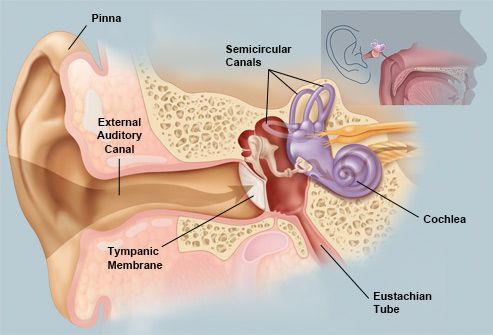
Hearing, too, is affected by things we can't see or access.  Even common wax can obstruct one's hearing without the patient knowing what it is that makes them hear less on that side (or both sides).  The inner ear itself, where the tiny middle ear bones transmit sound waves made into vibrations that are picked up by microscopic hair cells, is beyond visualization even for the ENT doctor.  It can be seen somewhat on a head CT in large scale but the hair cells that may not work as well for hearing as one ages or whose disruption with tiny stones (otoliths) can cause lifestyle-handicapping vertigo (dizziness) are beyond what we can easily access. 

                        http://www.webmd.com/brain/picture-of-the-ear

Hearing and Seeing
In a recent conversation, I was asked which sense I would rather lose - sight or hearing?  A difficult question to answer, and one that prompted a quick evaluation of all the taken-for-granted ways these senses affect my life.  The crescendo of a piano piece or the steady patter of raindrops.  A glorious nearly-neon sunset or the color of sunlight through a leaf.  Hearing someone call my name as I walk down the hall.  Seeing the identity of the speaker or identifying them by their voice. 

Sight and hearing are linked in another way.  Both senses require two steps to achieve the appropriate perception of sound/vision.  First, the external stimulus must be perceived - cells in the retina send off signals from the eye; those hair cells from the inner ear do the same after the vibrations reach them from the bones of the middle ear.  Second, the message received in the brain must be processed appropriately for it to give us the right picture or sound.  One needs both steps to actually achieve sight or hearing that is meaningful. 

The Bible understands the importance of both of these steps, too.  God's judgment on his people when he sends them the prophet Isaiah is:  "Be ever hearing, but never understanding; be ever seeing, but never perceiving...Otherwise they might see with their eyes, hear with their ears, understand with their hearts, and turn and be healed" (6:9b-10).  This is picked up in the New Testament in Matthew 13 (as well as parallel passages in Mark 4 and Luke 8) when Jesus understands why he speaks in parables, telling stories to communicate truth to those whose ears are open and whose eyes see clearly and concealing it from those who don't. 

My experiences on ENT and ophtho make me wonder: 
1.)  What sort of unseen blockages keep me from hearing God's voice clearly?  Pride.  Busyness.  Independence.  For many patients with wax in their ears, simple daily administration of a few drops of oil can help keep the wax soft enough to move out.  What similarly mundane practices can help my ears stay open?  Daily prayer.  Meditation.  Time in nature.  Time to listen.  Cultivating the practice of listening in my relationships.  Obedience when I do hear God's direction.
2.)  What overlooked glorious beauty and light is shining around me?  A simple mirror would enable the patients being examined to see the light illuminating their eyes.  How can I be a mirror to others, reflecting the Lord's light to them?  How can I be more attentive to God's presence and work in my own life? 

              http://stevetallamy.com/wp-content/uploads/2011/04/Seeing-Beauty.jpg

Wednesday, September 14, 2011

pain

 As I move into my second year of residency, I have acquired a number of patients with chronic pain.  This is challenging because of the regular number of prescription refills that then fill my electronic medical record inbasket requesting opiates (narcotics).  These are not medicines I have ever started a patient on on a chronic basis, and I hope to avoid doing so.  These patients, however, have been on these medicines for years in many cases, and it is left to me to try to help them deal with the impact of chronic pain on their lives, including writing prescriptions for medicines on which their bodies are now dependent to stave off the pain that initially debilitated them in various ways. 

In addition to my discomfort with regularly prescribing (sometimes large) quantities of highly legally controlled medicines, this situation has caused me to examine myself as I see my own reactions to these patients.  My level of frustration and feeling of helplessness surpass what I would expect from the need for frequent appointments, urine tox screens to ensure there is no other drug (ab)use going on, and simple script signing associated with these patients.  I hear the same frustration in other residents as they talk about these patients.  I think it comes from a deeper cause.

When interviewing for medical school, most applicants are asked, "Why do you want to be a doctor?"  The most common answer is, "To help [hurting] people."  I think the key is here.  We go into medicine hoping to help, to cure, to be part of healing.  Most patients with chronic pain cannot be cured or healed by the reach of medicine.  We seek with the pills within our reach to do some small part of helping instead.  And even that is complex.

The medicines used for chronic pain run the gamut from medicines used for regular pain (Advil, Tylenol, Aleve) to medicines used for neuropathic pain (gabapentin, pregabalin) to antidepressants to (sometimes) opiates.  This reminds me of the complicated nature of chronic pain.  It is a case-in-point of the integrated nature of who we are as human beings.  Our emotional, mental, and spiritual status deeply impacts our physical well-being and our subjective experience of our physical illnesses. 

Pain is hard, too, since it is so subjective; with chronic pain patients, often there's nothing there to point to and say, "This hurts" as one can to a broken bone.  Do I believe my patient's report of pain without questioning?  Is their early request for a refill evidence of undertreated pain or of possible abuse, taking more of the medicine more frequently than prescribed?  There's a lot of judgment involved, and it's hard to judge another's complaint of pain.

I think dealing with chronic pain well requires a re-working of how I think about the role of medicine.  It requires seeing a good part of my role as a doctor as that of care rather than cure.  It means seeking to remember the patient is a whole person and reminding them of it, that they are more than the pain that can become so all-consuming and -defining.  It is encouraging their health in the other ways that affect their experience of physical pain - mental, emotional, relational, spiritual.  It requires a steady balance of firmness and boundaries with compassion and connection.  It is challenging, and I'm not sure that I have it worked out; sometimes I think I lean too far with one patient towards leniency and too far with the next towards strictness.  Trying to achieve some level of evenhanded fairness while still feeling with patients' expressed pain and desire for relief that I can provide, even if it means an addictive, abusable medicine, is hard.  I don't want to become jaded or cynical but allowing my patients to manipulate me into giving them what they want if they may be abusing it is not loving to them in the long run, either.  It's a hard road to walk, and I'm still figuring it out.

Monday, August 22, 2011

stories 2

Before I start with the stories (altered, of course to preserve patients' privacy), I want to review the reasons I share them.  First, it gives me an outlet for processing and sharing the patients whose stories stay with me.  Second, it ensures in some way that I will not forget or grow numb in the busy succession of appointments and rounding.  Third, it forces me to stop and remember that each patient I encounter is first a person - a real embodied life whose body has a problem that leads to their encounter with me.  It encourages me to stop and look the person in the face, so to speak, encountering them as a human being as I review their story with you.  May it remind you in whatever your field is to do the same.

I saw my first rape survivor recently in clinic.  A 14 year old who was violated several weeks ago is now sitting withdrawn and quiet in the chair.  So withdrawn and quiet I had trouble feeling that my compassion and regret for her situation could seep in past the shell she had put up.  I felt very helpless, unable to reach her to comfort or support her, the protective barrier she had erected keeping out those intending her good as well as evil.  It is hard not to feel hopeless in these situations as well.  A friend's prayer as I shared my dismay over the whole situation reminded me that I am not ultimately powerless.  I can still pray that God reaches past her brittle shell and embraces her, enabling her to heal and grow past and despite this and not to get mired, stunted, in the pain and vulnerability. 

The next patient snapshot was a 26 year old G4P2012 (4th pregnancy, two living children, one abortion) at 8 weeks by her last period.  She had bleeding yesterday and went to a different ER where an intrauterine pregnancy was visualized.  She now is here for re-evaluation.  Ultrasound shows an empty uterus after she passed clots all day yesterday, and the baby's hormone (beta-hCG) level is dropping quickly.  The intern I am working with asks her after we give her the news, "How are you doing?"  And we watch her face crumple before she covers it with her hands.  Her sister, sitting with her, also tears up but doesn't move to offer comfort, so I move to the bed and put my arm over her shoulders and one hand over her hand on her belly and rock her, praying for her to somehow find peace in the midst of this disappointment as I hold her. 

The final patient whose story struck me was a 55 year old woman who cried through most of her visit as she told me of her history of physical, emotional, and verbal abuse in her 30-year marraige.  She shared how she finally left him after being really beat up one time about a year ago and of the ongoing abuse she endured at court appointments to get her support from him after their divorce.  I admire her courage for finally getting out safely (since the most dangerous time for an abuse survivor is when she decides to leave) while simultaneously wondering how she will ever heal from all those years of fear and betrayal.

Sometimes I marvel at all the pain people carry, wishing I had a sponge to sop it all up, leaving these lives I encounter a bit lighter, less weighed down with their wounds and worries.  I am reminded instead of something Stanley Hauerwas writes in his book, God, Medicine, and Suffering, "I cannot promise readers consolation, but only as honest an account as I can give of why we cannot afford to give ourselves explanations for evil when what is required is a community capable of absorbing our grief."  In other words, what we often need is not an answer to our anguished Why? so much as someone willing to comfort and walk alongside us in the silent space of isolation that suffering produces. 

In my words and actions, I seek in small ways to be part of a community capable of absorbing some of the grief I behold (see more on beholding in this blog post more than a year ago).  In my silent prayers for these women, I seek to bring them before a Community truly able to absorb their grief - the Father who can hold them, the Brother who intimately knows what it is to suffer and shares in their pain, the Spirit who groans their hearts' cries with emotion beyond what words can express to the throne of the Lord of the universe when they do not even know how to pray.  As Sarah Lance said in a quote I have across my computer screen daily, "I have the rare opportunity to share the hope of being found, known, loved, celebrated, forgiven and treasured by the God of the universe. This is my only answer for suffering."  May these hurting lives I encounter also have a chance some day to encounter that hope.

Tuesday, June 28, 2011

held

So I haven't blogged for a while, partly because I feel like I've had a ridiculously busy series of months through the late spring and partly because I haven't felt like I had anything to blog about.  I felt fairly emotionally burnt out for a number of weeks in April and May, and nothing really stood out to me.  I'm feeling better overall, but nothing struck me until I was reading the list of vital signs on pediatrics the other day.

The vitals come in a list with different headings:  blood pressure, heart rate, respiratory rate, pulse ox, etc.  But what caught my eye wasn't one of the numbers or its heading.  It was one of the entries under the heading "position," usually used to indicate sitting/standing/lying.  Since I am on pediatrics, however, this entry read a single word:  Held.


Such a powerful word.  In one syllable, it brings to mind images of a mother tenderly cradling her sleeping infant, a husband embracing his grieving wife at a graveside, a father catching up a child that runs to him to throw her in the air and catch her close.  It evokes the idea of security, of being valued and protected, of love and affection.  It reminds me, too, of the Natalie Grant song "Held" which explores the ways in which God is present for us, holding us, in the midst of life's trials and suffering.

Much of what makes me feel burned out are the things I carry with me - my own insecurities and shortcomings, my friends' or family's struggles or disappointments, my patients' suffering, pain, and resignation to the way their lives are that in so many ways fall short of what God intended (relationships, health, sex, loneliness, etc.).  What if I can find a way to let all I carry - and myself, too - be held by the Father, the weight of it all still there (because it is real) but no longer borne by me, no longer heavy on my shoulders?  If it takes feeling people's pain to learn to recognize his steady embrace, that's a price I'd gladly pay.  Because I do trust that whether or not I feel it, his arms carry me secure.  And maybe then I can invite others and their pain that so moves me into the strong love of the Father where they, too, can know what it is to be held.