Saturday, April 28, 2012

food (that is, fruit)

Ecuador has several foods for which it is known.  Guinea pig, or cuy, is one, but I haven't tried that one yet.  It isn't as common here in the Oriente (eastern part of the country).  Mariscos, or seafood, are common on the costa (coast).  Some foods, such as bananas and sometimes strawberries and the Costa Rican fruit I knew as mamón chino, go by different names here (guineo - bananas, frutilla - strawberries, mamones - achotillo here, lychee to my Asian friends in med school, rambutan in Wikipedia). 

 Mamones, or achotillo, or lychee.

I did get to out with some of the residents to nearby Puyo to try volquetero.  From what I can tell, it is sort of like a poor man's ceviche, made from a mix of chocho (a bean-like fruit/seed), maiz tostado (toasted corn), chifles (dried banana chips), tuna, and a salad of cebolla (onion) and tomate (tomato).  It was great!  I also got to try encebollado at a special breakfast at work, a traditional breakfast food, which also includes chifles, fish, tostados, yucca, tomato, and ají.

This is pretty much what our volquetero looked like, including the chunk of tuna from a can on top! 

Most of the other foods I have tried have been fruits.  Many are made into jugos (juices) that I drink at each lunch I buy:  frutilla/fresa (strawberry), mora (raspberry), tomate de arbol (tree tomato), guayaba (guava), guanabana, naranjilla (little orange), granadilla, etc.  Some of the ones I got at the store as well as others are pictured below. 

Pepino dulce, or sweet cucumber.  It was a fairly mild, bland, crisp fruit.  The name is appropriate.
 
Babaco, which is currently sitting in my fridge as I wait for it to turn more yellow, is supposed to be good made into a juice.  There is a blender in my apartment, so I plan on figuring out how to use it.  (We don't have one at my home in Lancaster, and I've never done much with one.  I think you just push buttons.  How hard can it be?)  :)

 
 Maracuyá, or passionfruit, is the yellow fruit which has a tart inside usually made into juice.  A patient gave me a whole bag of tomate de arbol, the red fruit above, so I need to make that into juice, too.

                              
I don't remember what this one is called.  I think I'm supposed to just cut it up and eat it.  

 
This is granadilla, which has sweet pulp surrounding black seeds on the inside, all of which you eat (although not the shell.

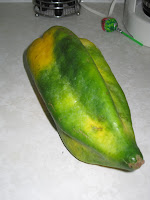
Not pictured are the papaya I recently bought at a small stand here in Shell and the lemons (called that although they're more like a cross between a lemon and a lime) we pick off a tree outside the residents' house to squeeze onto fish, avocado, and many other things.  Most Ecuadorian main dishes are accompanied by ahí, the national version of hot sauce that I think also has garlic and onions in it.  It's not very hot, at least in my limited experience, but does add a nice additional flavor.  Patacones (fried green plantains) seem to be a common side in restaurants, but platanos maduros (fried ripe plantains) are less common although often available upon request.  Yucca is common, both as a side and in soups.  Soups are very common - every lunch I buy has a soup on the side.  I have not found a lot of vegetables besides tomatoes, and I am very much looking forward to getting home, starting my garden, and eating my usual half-plateful of vegetables each night for dinner.  That said, I will miss trying new things, drinking freshly made jugos, and how cheaply I can buy fresh fruit here.

Friday, April 27, 2012

pacientes 3

I may have had my first Ecuadorian patient with TB last week.  She was a 74-year-old woman with a 6-month history of edema (swelling) in her legs that had worsened over the past week with associated shortness of breath.  It sounded like a classic picture of heart failure.  Her lungs sounded surprisingly clear, however, and she didn't have the cardiomegaly (enlarged heart) on X-ray or distended neck veins typical of congestive heart failure, although she did have impressive edema to her hips.  What she did have on the X-ray, however, fit more with her history of oral candidiasis with some odynophagia (pain with swallowing) and progressive weight loss:  a circular lesion with an air-fluid level suspicious for active tuberculosis (TB).  I sent her for AFB smears, as Ecuador requires two, and an HIV test, although she isn't coughing up blood and doesn't have night sweats (which with weight loss are the classic triad of TB), so I'm not completely sure of the diagnosis.  She sure has something going on in that left lung, though (see below).


This past week we admitted what is I think our third or fourth patient with snake bite in my time here.  This poor fellow had been treated in a different hospital a month ago, and the management had been suboptimal (especially not receiving antiofídico, antivenom, when he should have).  He had gone to a second hospital but left against medical advice when they recommended amputation of his right leg below the knee.  He went home and his wife put herbal dressings on his leg for the next three weeks until they decided to come here.  His entire anterior (front) leg was necrotic, and there is a 6-inch space between the skin on one side and on the other where there used to be muscle and skin.  Both leg bones are exposed, and on the X-ray below it looks like both have osteomyelitis.  He was resistant initially to the idea of amputation, but the surgeons have explained to him that it may end up being losing his leg or slowly losing his life from spreading infection.  He did have a below-the-knee amputation then towards the end of last week and seems to be doing fairly well.  Compare the moth-eaten appearance of his fibula (smaller bone) X-ray and the darkened out, infected marrow of his tibia (larger bone) with the normal image below.


I had another interesting patient in clinic this week, a 15 year old girl with 2-day history of epigastric and right upper quadrant pain, nausea, and vomiting.  Her exam had some mild epigastric tenderness and normal vital signs, and she said her vomiting was already getting somewhat better.  I figured it was a gastritis, probably from a viral infection, but they were worried about her having reflux, so I gave them a prescription for Tylenol and ranitidine and asked her to come back if she wasn't feeling better.  She came back three days later complaining of yellow eyes.  I did note some mild scleral icterus, although I had thought that was her normal pigmentation when seeing her at the first appointment, but she and her father agreed this was new, so I ordered blood tests for liver functions, including bilirubin (the cause of yellow coloring of eyes/skin).  To my surprise, she had not only mild hyperbilirubinemia (2.7) but also elevated transaminases (AST 200s, ALT 600s) and an elevated alkaline phosphatase (~AP 250).  I ordered an eco(sonografia) (ultrasound) and acute hepatitis panel.  She didn't come back for follow up today, so I don't know the answer (and I'm not sure how long hep A IgM takes here anyway), but it seems she may be my first patient with hepatitis A.  Either that, or she's the youngest patient I've seen with symptomatic gallstones!  Hepatitis A is usually self-limited and she is clinically already getting better, so she will probably be fine. 

cultura (culture)

http://www.perhapstodaycamp.com/contact-us

 I was interested before leaving for Ecuador to see how this expression of Latin culture would differ from my previous experiences in Honduras and Costa Rica.  Would South America hold different cultural traditions?  On the edge of the Amazon in the Oriente, would I encounter more indigenous people with their own cultural traditions.  Other than herbal remedies I've never heard of (e.g. cinnamon water to induce labor) and an occasional reference to believing in "both sides" (i.e. medicine and herbal remedies or sometimes spiritual causes of illness bordering on animism) or performing a limpieza (cleaning - done by a shaman for illness), however, much of what I've encountered has had much in common with my previous experiences. 

I have always enjoyed the affectionate nature of Latin culture.  In my month rotation in medical school, I remember struggling in India with the inability to touch people in public in a way that wasn't necessary for the physical exam.  I realized while I was there that I normally touch people informally ALL THE TIME.  My family is demonstrative, and I am also personally very much that way.

http://news.bbc.co.uk/2/hi/7040259.stm?lsm

So, here, I love the air kisses, cheek-to-cheek (as above), that I get from everyone on the resident/intern team and some of the nurses, too, when we encounter each other for the first time in the morning as we make our way around on rounds.  I love the easy hugs with the female residents/interns and the way I don't have to be afraid to pat children on the head or touch a patient's shoulder or knee.  I love the fact that I can grab a laboring patient's hand in a contraction and know she will mostly likely welcome the touch.  Yes, fellow LGH residents, you can make fun of me for wanting to comfort laboring patients with touch (cf. last year's Roast Night), but touch is a huge part of who I am; you know you enjoy my hugs, too, and it comes as a package! 

I also am reminded often of the importance of hellos and goodbyes in Latin culture.  The air kiss greeting is part of it, but even if you don't greet that way, you do always greet people.  You say hello to people in passing and buenos dias to the nurses in the hall on the way to a patient's room.  When walking into a meeting, even if late (although then it's whispered), you greet people with the greeting appropriate for time of day (buenos dias, buenas tardes, buenas noches). 

Goodbyes are also important.  The residents that have left have made a point of saying goodbye, usually in person, and expressing their appreciation/respect/affection as the situation makes appropriate.  They have also routinely given short speeches in morning report on their last day or so.  This might happen after an extended stay at another location in the States but much less commonly in a professional setting where it is expected that you rotate in and out routinely.  I have yet to give such a speech on a rotation to another specialty (e.g. gynecology, ENT, ophthalmology, surgery, etc.) even when I did feel much appreciation for the rotation, evidence of the ways our cultural expectations of despedidas (goodbyes) are different.

Time is dealt with differently here, as in much of the rest of the developing world (and even in parts of the developed world).  Something that someone tells me will happen ahora (now) or ahorita (right now) may not happen for another half hour or hour.  Both seem to be translated more to "in a little while."  It makes it hard to communicate to patients that yes, I do really want them to get that blood test right now if possible (ahora mismo has become my attempt at communicating this) rather than tomorrow or next week.  Even ya (already) seems to take on more of a "soon" translation in some contexts.  On the other hand, patients are extremely patient waiting for their turn to be seen (no advance appointments) and then waiting for their test results that help to determine their diagnosis and treatments, for which I am grateful.

Although for the most part I have enjoyed Latin culture, there are also cultural things that are not as much fun, the primary one being gender expectations.  I have been pleased to find that I have experienced almost no treatment that seems to differ because of my own gender, unlike some of my previous experiences.  Even the piropos (catcalls) so common to a gringa walking anywhere in Costa Rica are rare here.  Nurses listen to me (including the one male one I have met), and our male intern treats me with respect.  Patients also seem to listen to me, regardless of whether they are male or female.

However, I have now encountered two fourteen-year-olds pregnant by a much older man.  This is illegal here, and I think legal procedures were followed in both cases, but it does still point out the ways in which women can be treated differently.  I see teen moms routinely in my practice in the States - less commonly young teens, but their boyfriends are usually also in their teens, not their 20s, 30s, or 40s. 

Another evidence of differing expectations of men and women is the way in which some of my female patients will bring a husband, brother, or uncle along to their appointment who speaks for them.  It can make for interesting history-taking when I'm not sure which questions I can ask in front of the relative and not sure whether their answers are actually the true history or just what they think is happening.  It is further complicated by the fact that these are often indigenous women whose Spanish level of understanding is uncertain, so it's not clear to me what the reasons for the spokesperson are - linguistic or cultural or both. 

Overall, however, my experience of Ecuadorian culture has been very positive.  I've enjoyed trying new foods (although I have yet to try cuy, Ecuadorian specialty of guinea pig), greeting with air kisses, saying goodbye well, and generally feeling welcomed to an emotionally warm environment.  I will have to see how much I've learned of the culture when I have my own chance at despedidas next week.  I can't believe I have only a week left!  I will miss the interesting cases and regular use of Spanish, but I am also looking forward to seeing family and friends again regularly.  And it won't take me an hour to walk to the grocery store for fruit like it did tonight (since I got lost in the dark on the way back), although then again the avocado that is now soaking in disinfectant solution in my sink wouldn't cost me $0.35 and five apples $1 and five bananas $0.50 in the States, either.  :)

Thursday, April 26, 2012

español (Spanish)

I've had a lot of people asking how it's going with Spanish here.  Overall, it's been fairly painless and almost effortless.  I'm certainly gaining in filling the small pages of the little book I carry around with me to write down new Spanish words to look up or English words to look up how to say in Spanish.  The medical abbreviations and physical exam, of course, are the most challenging new thing and the ones I use most often (some of them, at least).  It reminds me how much of its own language medicine is, with the abbreviations I now take for granted.  UTI (urinary tract infection), CVA (cerebrovascular accident - stroke), AMI (acute myocardial infarction), CBC (complete blood count), UA (urinalysis), PE (pulmonary embolism), po (per os - oral), q6h (every 6 hours), r/o (rule out), and many more all have their own parallels in Spanish.

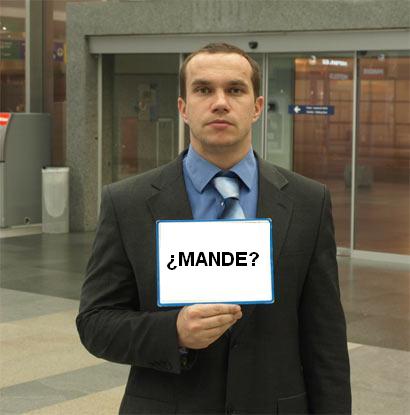
Ecuador doesn't seem to have quite as much pachuca (Costa Rican word for slang) as Costa Rica from what I can tell.  There have been a few interesting exceptions, including some medical stuff (but I won't get into the fact that I have to ask personal questions of patients on a regular basis and that they say some of them differently here).  Perhaps the most common thing that was new to me is the use of mande to mean "What?" or "What did you say?" 


God seems to be much more an accepted part of Latin worldview, and it shows up in the language.  I commonly tell patients, Que Dios le bendiga (May God bless you) in Spanish, which I would almost never say in English, not because I don't wish it for those I encounter but simply because it's not as much an assumed part of the shared worldview.  I have also had a number of patients refer to future plans with the conditional si Dios quiere (if God wants/wills).  I'm not sure how much of that is a conscious self and public reminder of our own place in the controls of the world and our lives and how much is simply an unconscious saying, but it is a good reminder to me at any rate, whose lack of familiarity with the common use of the phrase forces me to encounter it and its message anew.

I thought Costa Ricans were known for diminutives, which is where they get their name Ticos (from adding -tico to the ends of words).  But Ecuadorians certainly do it a lot.  Nearly everyone's names that end in a vowel (and even if they don't) becomes "-ito" (e.g. Marita, Anita, Pablito, etc.).  It is added to terms of affection, which are used much more liberally here, such as asking someone to climb onto the examining table with the affectionate term mi hijito/a (my little son/daughter).  This is commonly used with patients regardless of whether the patient is one's senior in years or not, although it's certainly used more with children.  It's not the paternalism it would imply in English, but it is taken for granted to be a more demonstrative relationship than many physician-patient relationships in the States.

Obviously not my picture.  (For those of you who don't know, that's not me.  :))  But just too cute not to use.

Thinking of terms one calls children, I love the variety of terms Spanish has for crooning at babies:  mi cielo (my heaven), mi amor (my love), cariño (affection), mi vida (my life), mamita (literally, little mom, but it doesn't really translate like that), mi reina (my queen), and corazón (heart) among others.  Many of those things I would never be comfortable saying in English to random babies, but I croon many of them regularly as I examine newborns or see infants in the consulta externa (outpatient clinic).  I don't know for sure what parents think of it, but I think in general Latin culture probably doesn't mind the affection.  :)  At least, I sure hope so!

Saturday, April 21, 2012

friends

My first night in Ecuador was very lonely.  I am used to living with two housemates and a dog, and the change to a relatively large, empty apartment by myself after a week with my family was rather abrupt.  That has changed dramatically thanks to the Ecuadorian residents and interns that have shared call, stories, evenings out for dinner, laughter, meanings of vocabulary words, eating hospital-prepared food, and cooking with me.

There are three Ecuadorian residents, most of whom are in family medicine doing their post-grad (residency) but some of whom are licensed physicians who have finished medical school but haven't decided to do residency in a specialty yet.  My first group of residents had two family med post-grads, a second and third year, and one general practitioner.  Then there are three interns, who are sort of equivalent to fourth year medical students since they aren't physicians yet but who have finished more than two years of rotations and function more on an intern level.  They are comfortable doing much that I don't generally do, including drawing blood, starting IVs, giving neb treatments, etc.  On the other hand, I'm comfortable managing things they don't see as much of like COPD or CHF.

This is Marita, Anita, and Marito on a trip to Puyo for volquetero, an Ecuadorian typical snack/meal.  Anita is a GP equivalent, and Mario and Marita are interns. 

One of my favorite evenings hanging out with the residents occurred this past week when we decided to make burritos together.  They also requested apple pie.  I obliged with an easier (since we didn't have a pie pan) apple crisp.  We went shopping together, and I discovered parts of Shell I didn't know existed.  We made the meal together, and I found out the Ecuadorian way to make burritos (no separate tomatoes or cabbage, my family's usual, but tomatoes cooked with ground beef and onions).  During the meal preparation, they took turns helping and sitting in front of the TV karaoke machine, unself-consciously singing along with the microphone to various folk songs.  It was great fun to sit down together, all eight of us (with an American college student visiting for the week thrown in), and talk and laugh and enjoy a break.  Even the call team was able to be there for the evening as they had a slow night.  Here are some of the pictures.

Estefania, Marito, and Marita, our three interns, helping to shred/crumble the cheese.  I am thankful they will continue with me another week as the residents change rotations this weekend and will go back to Quito.

Our American college student shadowing for the week, Courtney, and la Gaby, an Ecuadorian second year family practice resident who has the unenviable task of balancing a 2-year-old with her and her physician husband's schedules (he works at a children's hospital ICU in Quito).

Anita, our GP, and I.  She plans to go into internal medicine and possibly palliative care.  We have shared call while I'm too cowardly to take call on my own as the sole resident, and she's been great to work with, a patient fount of vocab words, jokes, songs, explanations, and support.

Pablito, our third year family medicine resident, provided most of the meal production entertainment.

Most of the crew, although Pablito took the picture and Marita had gotten called away to the emergencia to see a patient.

I am so thankful for the quick welcome and easy friendship of these other young adults.  It has been a humbling pleasure to be so easily included in their activities, and it makes me wonder how often I do as good a job at making others feel welcome.  Their medical knowledge is impressive, and their social circle is unquestionably a huge part of why I am enjoying my time here.

Ecuadorian beauty

Somehow a week into my time here, I've already become accustomed to the hushed patter of raindrops on the broad leaves of the tropical trees and plants across from my house.  Despite this, I still find the musical rainfall on the metal roof overhanging my porch enchanting. Because it's rainy season here, there are almost always clouds in the sky.  The mists of low-lying clouds hang suspended over the foothills of the mountains as the rain begins to sprinkle.  The snow-capped mountain tops of the Andes to the west that I saw this morning are now completely covered by the blanket of clouds lying over and between me and them. 
 
  
I'm not very good at capturing this, but the mountain barely visible on the left third over the hospital of the first picture is one of several active volcanoes in the area (relatively).  We saw ashes rising from it the other day.  The mountains in the second picture have snow when it's clear.

Seeing the snow-capped mountain tops on a clear day, usually in the morning on my walk to the hospital to round on patients, is striking.  With the near-constant cloud cover, I miss the stars, but the clouds make for glorious sunsets, sunrises, and vistas.  I find myself wishing for a water tower or something to climb from which to have a higher view. 


There is also amazing natural beauty.  There are some flowers that look familiar, and many that are not.  They range from rose bushes to orchids to poinsettia bushes to the brightly colored bougainvillea I have enjoyed in other locations.

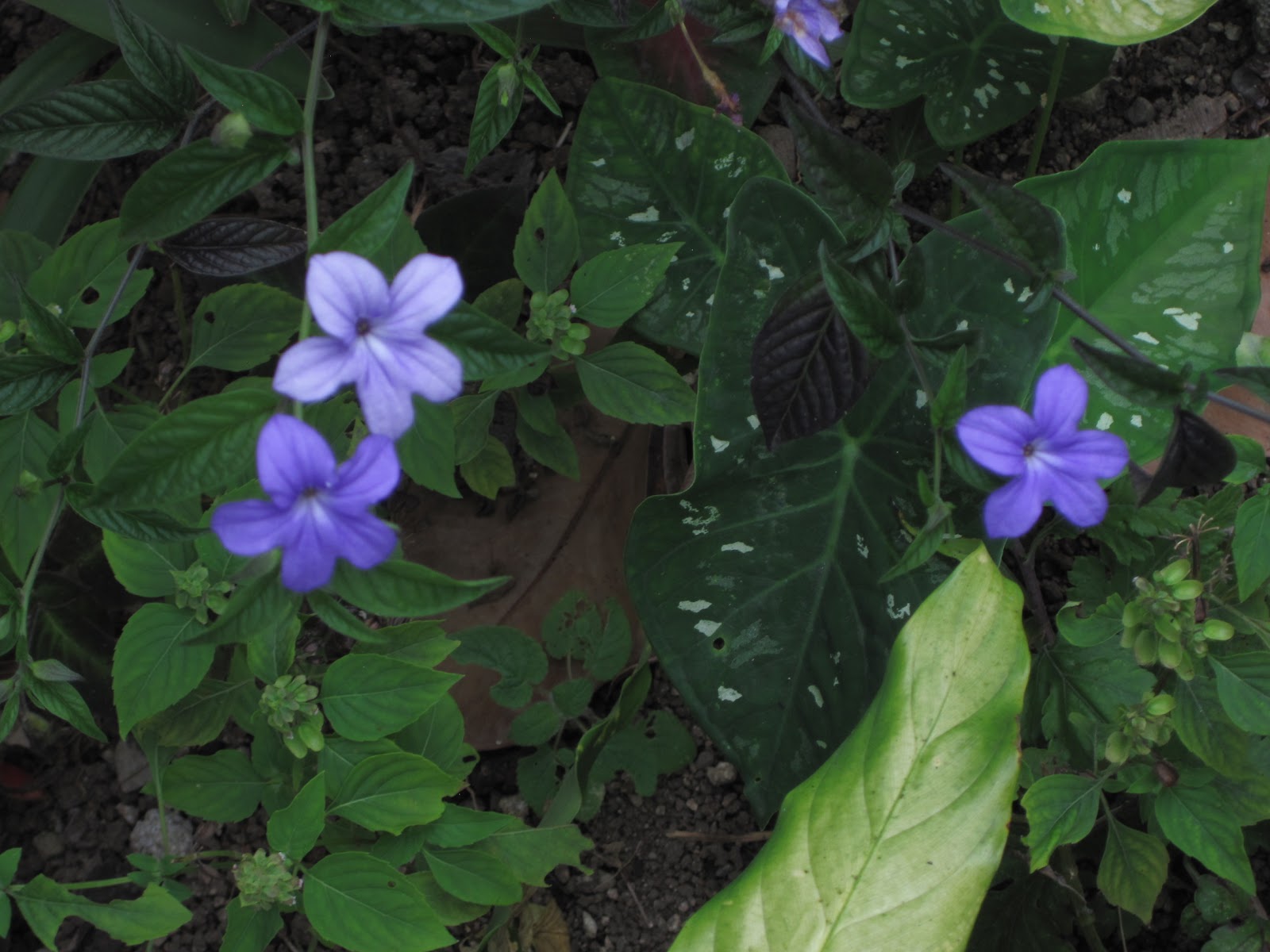
These beautiful flowers are some of several outside my door. Second, a close up of the flowers that grow outside my door.  The detail and colors amaze me.
These are some of my neighbor's rose bushes and beautiful periwinkle-colored flowers that grow outside my neighbor's house.
A bird-of-paradise (I think, at least) on a evening walk with some of the residents and interns.

Friday, April 20, 2012

pacientes 2

The interesting cases continue.  We had a 70-year-old woman come into the emergency room the other day complaining of 3 months of feeling like her entire left side was amortiguado (numb).  On exam, we weren't entirely convinced that she was actually numb or if she was having paresthesias or just decreased sensation, so the attending came in to confirm the story.  He pinched her, used a tuning fork, and finally poked her with a needle, drawing blood without reaction, confirming that she was in fact numb.  Although MRIs are not readily available here, she had had a normal head CT, so she probably had a small lacunar stroke that didn't show up on the head CT that left her with hemianesthesia.  She was complaining of also having pain, and apparently one can get a delayed central pain syndrome after a unilateral sensory loss.  Since gabapentin is not readily available, we started her on amitriptyline and had her follow up as an outpatient. 

Another case that will stick with me is the previously well 4 month old baby boy who came in with severe pneumonia.  He progressed to intubation and was being managed on our vent but was requiring high pressures and had worsening chest X-rays and we were unable to wean the oxygen requirement.  It looked like a picture of juvenile respiratory distress syndrome, and when he did not improve, we tried to transfer him to Quito but were unable to due to a severe storm.  His mother stood by for days, watching her baby's swollen body fight with the vent and periodically asking us when she could breastfeed him again.

 For those of you who are non-medical, white in the lung fields is bad.  Our baby started out with a pneumonia (top left), progressed to respiratory distress syndrome (mid right) and then improved to nearly normal a few days after our prayer.

The day the transfer couldn't happen, we went into the room and talked with the mother about his poor prognosis.  At the end of our talk where we confirmed that he could die from this (and I was thinking he probably would), the attending asked if we could pray with her.  She agreed, so the three of us stood around the bed with the struggling little body and prayed.  My heart was heavy as we walked out.  The next day, however, against all odd, she came off the ventilator and was switched to CPAP.  The following day he was on nasal cannula oxygen and that was rapidly weaned down.  He remained in the hospital several days after his oxygen requirement had finished to finish his required days of IV antibiotics, smiling at everyone as his mother carried him around the halls, but he went home today.  His story is part of the reason I want to work overseas.  I want to see God do miracles.  And I can honestly say I think I just did. 

I have gotten to see a good bit of obstetrics here.  We had a delivery the other day for a 44-year-old woman whose 10th child this was.  I have to say I don't think I've ever delivered someone with quite so many G's (pregnancies) and P's (births).  For the most part, OB is similar, although little things are different, like how they hold their hands to try to avoid tears during delivery, a practice of cleaning everything around the birth canal before the baby is born, the routine use of intermittent fetal monitoring (about every 2 hours until pushing and then often after only every few pushes).  The complications are the same, though, and there was a shoulder dystocia a few days ago (although not on one of my deliveries) and an external cephalic version today of a breech baby.  One of my deliveries there was more blood loss than expected, and it turned out to be a cervical laceration, which I had never seen. The patient had gone from 6 cm to 10 cm (fully dilated) in 40 minutes, much faster than expected even for her second delivery, which is a risk factor for cervical lacerations.  The attending repaired the laceration, and it was good to get to see how to do that.

I've also seen some routine things I hear about in the States but just hadn't seen yet.  One of the few overweight children I've seen, a 10-year-old girl, came in with difficulty walking for past week and severe pain with any movement of her right hip.  It turns out she has a slipped capital femoral epiphysis (SCFE - the top of the long bone in the thigh essentially gets shoved off to the side), so one of our surgeons took her to the OR for a fixation.  Based on an ultrasound, clinical history with irregular menses, and infertility, I diagnosed a patient in clinic with polycystic ovarian syndrome (PCOS) and started her on metformin in hopes of increasing her chances of getting pregnant.  I had a 7-year-old girl in the outpatient clinic with diarrhea who turned out to have both amebic dysentery and giardiasis.

 This was our little girl with SCFE before and after fixation of her epiphysis.  You can just barely see in the picture that her right epiphysis ends lower than her left.

I'm on call again tomorrow, so I'm off to bed but hope to write more soon about how it's going with Spanish and about what life is like here.