Showing posts with label culture. Show all posts

Wednesday, March 9, 2011

trafficking, shame, and freedom

Human trafficking is an issue that has come up recently in efforts to raise awareness - yes, even here in rural southeastern Pennsylvania.  A quick search of related websites indicates probably 27-30 million people under modern-day slavery, forced to work or be a child soldier or a prostitute often in a place where they don't speak the language.  It's an ugly issue, one nearly overwhelming with the myriad of stories of abuse and rape and shattered lives.  And yet it is one where I as a person in medicine have the possibility of playing an important role in recognizing victims.  Look beneath the surface, the presenters urge.  Look for the signs that might indicate a powerless person with no control over their employment, income, place to stay.  And the corollary:  Be willing to help.

It reminds me somewhat of child abuse.  Physicians are always obligated to report suspected child abuse, even if they are not sure.  The investigation is out of our hands, but the error must always be on the side of protecting a helpless victim.  This feels similar - the obligation to help, to know what resources are available - with the added complication that this is sometimes an adult, so how do I offer help in a recognizable form to someone used to betrayal?

Perhaps the most important step starts with the step illustrated by this Ten Shekel Shirt song, "Fragile:" http://tenshekelshirt.com/.  "It's Not Your Fault."  The people who came and spoke at my church about their work among former victims of trafficking told stories of seeing new life come when women began to find forgiveness for themselves.  Often their own way of seeing themselves kept them in captivity.  But they have found a way out of that crippling shame through Jesus, and it transforms their lives.

Shame is not limited to victims of human trafficking, however.  It is found as well in the physician addict who secretly shoots up opiates scavenged from the ER sharps box.  It is found in the young man with hallucinations who can't seem to escape the clamor of voices inside his head.  It is found in the survivor of domestic violence who goes back once again to the abuser, hoping against hope that this time will be different.  It is found in my own heart with my struggles and failures.

I read a book once that spoke of shame, saying, "Shame enters in and makes its crippling home deep within our hearts.  Shame is what makes us look away, so we avoid eye contact with strangers and friends…  We know we are not all that we long to be, all that God longs for us to be, but instead of coming up for grace-filled air and asking God what he thinks of us, shame keeps us pinned down and gasping, believing that we deserve to suffocate... Shame causes us to hide.  We are afraid of being truly seen, and so we hide our truest selves and offer only what we believe is wanted."

I think of that image often as I interact with the hurting people that cross my path, their regrets and disappointments combining nearly to suffocate them.  I think of it today, Ash Wednesday, as I think about the vast heart difference between shame and repentance (which is the season of preparation for Easter that Ash Wednesday initiates).  One leads to that crippling sense of suffocation; the other leads to walking head up and eyes on Him in freedom and life.  As the Anglican liturgy says, 

"Praise to you, O Christ, King of eternal glory.
The Lord is a great God, O that today you would listen to his voice.
Harden not your hearts." cf. Psalm 95.3, 8 

"Remember that you are dust, and to dust you shall return.  Turn away from sin and be faithful to Christ," the priest reminds as he puts the black powder of the ashes of last year's Palm Sunday fronds on our foreheads.  It is a reminder of our fragility and our mortality, a truth I see daily in my work.  But more, it is a reminder that out of death we, like all in slavery - physical or spiritual, are called to life, out of binding shame to joy overflowing, out of sin through repentance to holiness and wholeness.  Harden not your hearts...

Sunday, April 25, 2010

names

I have always enjoyed having a unique name and knowing what it meant (one whom God has promised) and its origin (Hebrew, the story of my birth, etc.).  And part of encountering another culture is learning new names and how to pronounce letter combinations you thought couldn't go together.  :)

In Zambia, I had a different problem:  not smiling at people's names, picked in some cases - I am sure - for how the parents liked the way the word sounded in English even if they didn't know what it meant.  Or they simply name their children Tonga words with interesting meanings.  Here are some I wrote down along the way:

English:  Agrippa, Cleopatra, Only, Obey, Fines, Modern, Favourite, Purity, Precious, Pritness (Prettiness)
Tonga:  Linda (awaited precious one), Trouble, Change-of-sex (as in a girl after a number of boys or a boy after a number of girls), Same-sex (opposite of above)

So even our names carry something of culture in what is appropriate to name your child.  :)

culture, take 2

On my flights back and in layovers, I started reading a book I have owned for a number of years but never got to read, On Being a Missionary by Thomas Hale.  His chapter on culture shock/stress made me think again about my entry on cultural differences.  I recognize much of his symptoms of culture shock in myself over the past eight weeks particularly: discouragement, critical spirit, self-pity, pessimism, etc.  I know and knew at the time that I was experiencing some stress from the difference in cultures.  It simply costs more emotional energy to do simple things like going to market when you have to say no to several people who want money or a job, ignore some propositions or comments, try to figure out what I'm going to do with the few vegetables available that my stomach won't reject, and then gauge whether the price I'm offered is a fair one or whether I should barter a bit and if so how much to offer and whether the seller speaks English...

Hale goes on to talk about what to do for culture shock.  His steps include recognition, praying for God's grace and enabling, adapting to the nationals except for ethics and faith, making a circle of friends, cultivating an attitude of exploration/adventure, maintaining friendships with other expats, and not taking yourself too seriously.  I was struck as I looked over this list by how little of this I did.  I was much quicker to judge and criticize than to ask God for his enabling to love those around me.  I was much quicker to relate to the simpler relationships with expats than to invite over Zambian friends, even for the little hospitality (tea, games) I could offer.  And this is me, who prides myself on enjoying the challenge of cross-cultural relationships and cultivating a good number of them, including among my closest friends.  Have I been deceiving myself and simply requiring my friends to respond in ways that fall within my expectation or do not require challenge or change for me?

Hale speaks of the way in which Jesus gave up so much to be with and for us, to die in our place, to rise to give us a victory we could never earn but in which we are welcomed lavishly, generously, joyfully, grace-fully to share.  He reminds the reader of how love is shown forth in one giving his life for his friends, and how those of us who serve cross-culturally in an attempt to show Jesus' love for others have a unique chance to give up our lives (our things, our culture, our status, our privileges, even sometimes literally our lives) to demonstrate that love.  How little of that was present in my thoughts and attitudes, although I hope a bit more of it was present in my actions...

So this is my confession.  I have far to go in learning to be like Jesus, who willing and without complaint gave up a place in heaven to be born in a stable, to work as a carpenter, to be rejected and ridiculed, to be humiliated in death and misunderstood in life.  I do not love my neighbor well.  Lord, help me to grow in this, particularly when dealing with the additional stresses of cross-cultural relationships.  Am I willing to be misunderstood, to be rejected, to be unappreciated or ignored?  Am I willing to have my medical judgment questioned, my competence doubted, what little knowledge I have worked to earn ridiculed?  Am I actually willing to follow where Jesus leads and expect nothing in return?

I am reminded of 1 Corinthians 13, the so-called love chapter.  Verses 2-3, 8a: "If I have the gift of prophecy and can fathom all mysteries and all knowledge, and if I have a faith that can move mountains, but have not love, I am nothing. If I give all I possess to the poor and surrender my body to the flames, but have not love, I gain nothing...  Love never fails."  Lord, teach me to love like you do.

Monday, April 12, 2010

culture

I've been thinking about how I don't post about Zambian/Tonga culture like I did about Indian culture.  I think there are two primary reasons for that.  One is that, although it's new in my remembered experience, much of Zambian culture is not surprising to me since I grew up hearing about it from my parents.  So the fact that I curtsy when shaking hands, that one shows respect for the person greeted in shaking hands by placing the other hand below your own outstretched arm slightly distal to the elbow, that women carry the heavy loads and the children, that we eat nsima and relish with our hands, etc. simply don't strike me as novel.

The second reason is the more difficult for me to acknowledge and process.  There are parts of Zambian culture that are difficult for me personally, particularly as a woman.  In many small ways, I am treated differently because I am a woman.  Different things are expected of me.  I think women and men also have similarly different roles and expectations of behavior in parts of India, but those roles/expectations didn't apply to me as a foreigner.  Because of this, they didn't bother me personally so much.  I feel half ashamed of this; should I care more about these different expectations only if they impact on me?  Then again, their impact on me may be greater at least as far as my adjustments to them than on the people who grew up in this culture and so have their own expectations more shaped by it.  But maybe I'd just like to think that so that it makes me feel better that I don't mind the cultural differences as much when they don't affect me.

It comes back to bigger questions about culture, too.  For the most part, I enjoy cultural differences and learning about other cultures.  But I don't think other cultures or my own are above moral judgment.  Just as there are things in my own culture that I wish were different (e.g. materialism, time-focus over people-focus, prizing status and influence over character and inner worth), there are things about other cultures I wish were different.

What is hard is making judgments about another culture from the outside rather than my own from the inside.  Am I simply more sensitive to things that are right and wrong here because they are different?  How can I learn to be more sensitive to what is right and wrong (and not above judgment) in my own culture from being within another?  How can I balance suspending judgment here while learning more about why things are the way they are and trusting that some things are value-neutral and simply different with acknowledging that some things simply should be different here as well as in my own culture?  I don't have any easy answer, certainly not for how I live it here and now or in the future, but I suppose it's good to be asking the questions.

Monday, April 5, 2010

Easter in Zambia

It was certainly a weekend full of festivities here.  Church services Thursday, Friday, and Saturday nights were followed by a 5 a.m. Sunday morning Easter sunrise service, 9 a.m. communion service, and 10:30 a.m. Easter morning service.  The Easter sunrise service was particularly neat since I remember going to these as a child (and being disappointed by an 8 a.m. "sunrise" service in the States that was after sunrise and inside!).  It was neat to be there with mostly women and be reminded of how the women were the first ones to the empty tomb and the first witnesses to the Resurrection.  This is a culture in which women are definitely second to men in priority, and the culture of first-century ancient near east was no different.  So the honoring implicit in the women's primacy in this central event of the Christian story is particularly special.


All the services involved much singing and rejoicing.  There were some culturally specific ways of celebrating that were unique.  The women go to the sunrise service wrapped in sheets (or old mosquito nets!) to commemmorate the linens which had wrapped the body of Jesus that the women found forsaken in the empty tomb.  I forgot mine, but I did manage to remember to borrow a scarf to wear to cover my head so that I would be allowed to participate in the communion service later.  I come from a church tradition often associated with head coverings - Mennonites - and some people in my home church do wear coverings, but I had never worn one before.  It was an interesting experience, thinking of doing something I don't consider necessary to partake in this community's celebration of faith in equal standing.  Then again, I wear skirts every day (something I don't think necessary for women) so as not to offend and to participate in the local community's life as much as possible on the same level...


After the services, we went over to the Thumas for lunch, which included some visiting friends.  We ended up chatting for the afternoon and went home briefly only to join up with Abby and Heidi, two other expat young women, to go for a walk to see the sunset.  So the day which began before sunrise ended with the sunset - altogether, a very satisfactory day.  :)  Pictures to come.

Wednesday, March 24, 2010

overdue thoughts

Sorry to have had so much time between the last real post and this one, which will be relatively brief since it's almost midnight here.  The combination of lack of functioning internet, sharing Mike's computer with him (thank you, Mike!) since mine continues to refuse to turn on, and the recent inundation with residency-related matters to try to handle at a distance has left little time for blog postings.  But here we go.  I'll do it in a bullet-type format since that seems like it might be most efficient.

* I have now heard the wailing that Zambian women do when someone dies after hearing about it from my parents growing up.  I don't know that I've heard a more poignant sound than the almost-musical mourning that goes up and travels with its producers around the hospital campus announcing the family's new grief.  It never fails to make my throat tighten up and sometimes bring tears to my eyes.

* Bryce visited Macha last weekend after our trip to Livingstone with him the weekend before.  Mike was happy to have another guy around, and the two guys, Heidi (a SALTer), Abby (an MCC nurse and Jeff grad), and I had fun playing Dutch Blitz one night. 

* Recent meals with both the Thumas and the Spurriers, the two long-term expat families here, were helpful in building relationships and also in providing cultural and historical insights.  It made me proud of the way the church here is national-run (and the services much different from churches in the States) and nationals and expats work together in the hospital.  Their stories of long-term successes against measles, neonatal tetanus, and now increasingly even malaria were also inspiring tribute to the benefits of working in one community for years and years.

* We came back from Livingstone last week to find that Carl, Mike's cozy immobile wall spider, was gone.  He hasn't shown up again, which is probably to his health benefit.  That said, there are apparently still-living spiders now on Mike's side of the room.  And Mike reports he barely notices the spiders on the walls in the lounge here in the dorm.  Progress has been made.  :)

* Mike leaves tomorrow (and with him my access to a computer for a few days) for Lusaka, and Linda arrives in Livingstone on Friday.  I will go down to Livingstone to meet up with her, and then we'll meet up with a couple other Macha expats to travel back to Macha on Sunday.  Hopefully that will make the apparently-inevitable taxi ride (~$50-80/trip vs. $3 for the trucks) cheaper to split up since the trucks don't run on Sundays.

Thursday, March 11, 2010

weather, money, and medicine

India was definitely getting hotter by the time I left, so it was a bit of a shock to come here to a week of rain and cool temperatures that made me wish I'd brought more ankle-length skirts and long sleeves.  This week, though, it's been warmer and sunny.  I'm back to being happy to be in short sleeves.  I anticipate getting wet again this weekend, though, with some great views at Victoria Falls.  I just hope the sun holds out for our anticipated trip to Chobe Game Park in Botswana.

People ask us for money a lot here.  Or they ask to do our laundry or sweeping for money.  I tell them I do my own laundry (by hand), which is true.  I haven't found the best way to deal with or think about being asked for money.  Obviously, the perceptions of Western wealth on one hand are inaccurate - at least in my case, since I'm >$200,000 in debt for med school.  On the other hand, I do live a life of incredible privilege in so many ways, partly shown by the very fact of my being in this country.  So I simply smile apologetically and say no for the most part.

Medicine is quite different here.  Not so much because we see different diseases, although we do (I've seen at least four cases of cryptococcal meningitis in a week and a half, which I never saw in the States, although I know it happens; I've also seen lots more TB, HIV, and rheumatic heart disease here than in the States).  But because of the setting, even our first-line medications for common conditions are often different - for pneumonia or PID, for meningitis or CHF.  So it takes some adjusting and insecurity can come with that.  But I'm learning and thinking and asking questions, and I suppose that is good.

Friday, March 5, 2010

adjustments

I think I hadn't realized  how much I had grown accustomed to things in India in my short time there.  I found myself the first few days (and still now) constantly wanting to comment on how things here are different than there.  Life here is just less crazy in many ways, partly because there are fewer people - traffic is less hectic and life-risking, people are not crowding walkways and towns, etc.  It's interesting...

I find the juxtaposition of two foreign countries coming up in other ways, too.  I was trying to ask a patient whether she had a headache after a LP (lumbar puncture - spinal tap in common parlance) and ended up combining my newly acquired Tonga word for pain with the Tamil word for head instead of my recently heard Tonga word for head, resulting in a confused patient who then asked me in English what I wanted to know.  Oops. 

Those adjustments aside, life here has been good so far.  The schedule is approximately 7:30 a.m.-5 or 6 p.m. daily with ward rounds in the mornings Monday, Wednesday, Thursday, and Saturday and OT (operating theatre - operating room in the States) in the morning on Tuesday and Friday.  We see patients in the outpatient department (OPD) in the afternoon every day.  Lunch break is some time between 1 p.m.-3 p.m.  Mike and I are sharing call with another fourth-year med student, Adrienne, from the States on a q4 basis, which means we go in for evening rounds (8 p.m.-10 p.m. or so) and are available for any OR emergency cases at night every four nights.  Our two other fellow ex-pat students, Sarah and Beth, left today for the States.  So the remaining three of us are settling in for the next few weeks. 

Monday, March 1, 2010

arrival #2

Mike and I have arrived in Zambia.  After about six hours (for me - four for him) of sitting and waiting and walking around looking for Mike (me for him), we found each other in Heathrow in time to head out to our gate. An uneventful flight followed, and I got to sit next to a friendly Malaysian ex-pat living in Lusaka about her life and insights into Zambia and its cultures around sleeping about six hours to make up for my one to two hours of sleep the night before.

After arriving in Lusaka and changing money, we caught a taxi to the bus station in Lusaka to head to Choma.  The next available bus was air-conditioned and beautiful, and the road was also in good condition.  After a month in India, I was astounded to be in a taxi and a bus with no honking and maintenance of one's own lane on the road!  Mike and I met a friendly other makua (spelling? - white person) on the bus who turned out to be a Mennonite from Lancaster County living in Choma for about ten months with the SALT program through MCC. We'll see if we can manage to connect with Bryce again for a trip to Victoria Falls or a game of Dutch Blitz at some point if he visits the other SALTer in Macha.

Bryce helped Mike and I run errands in Choma and then connect with a van to Macha.  The van's readying for departure was a cultural experience in itself, and I decided I was going to learn a lot about patience and waiting while here.  First we waited in the van for something unknown.  Then we waited for the engine to turn on, which it did after lifting the front seats and pumping something in the engine.  Then we sat with the engine running for a while longer.  Then we pulled out and drove to the gas station, where we waited.  Then we drove to a local shop and the driver got out and did something unknown, and we waited.  Then we pulled back into the original spot, loaded three more adults plus a baby in, and finally departed.  The initial 45 minutes were paved and smooth, but the final hour and fifteen minutes on unpaved, pothole- and stones-ridden dirt roads, gave me renewed sympathy for my dad's experience going on the six-hour drive from Lusaka to Macha 23 years ago with a broken leg.

We are now settling into the very nice MIAM dorms.  I have a room to myself with three other unoccupied bunks, and Mike (as the only guy right now) does, too.  There are three other female students here, too, two of whom share a room and one on her own.  They've been very friendly as we settle into the details of life here (when to eat, where to eat, how to use the internet, when to show up tomorrow morning, etc.).  I'm excited and looking forward to some exciting stories in the near future whenever the internet is working.  :)

Tuesday, February 23, 2010

leaving...

We leave CMC today to go to Chennai to meet up with Swetha and catch an overnight train to Kerala, where we will be traveling for a couple of days.  I'm excited about the overnight train since it's apparently a staple of the Indian travel experience.  Hopefully it's a restful staple!  :) 

In Kerala, we will do a backwater houseboat overnight tour from Thursday to Friday morning.  Then we will travel to Kochin and see whatever there is to see there until our overnight train back Friday morning to Saturday morning.  We will hang out with Thenu and Nithya's families until my flight at 4 a.m. on Sunday morning to Zambia via Heathrow.  Mike, I'll see you in London in a few days!

Some things I've been noticing about south Indian life as I think about leaving:
  • turmeric on the hands and faces of women in the clinic - apparently it's for married women for good luck
  • the different standards for space and touch here - you don't touch when greeting or saying goodbye, although some people will offer me the Western handshake, but you do sit right up next to anyone else on the bus or brush by anyone else without the expected apology in Western culture
  • the temperature - it's definitely getting hotter than the warm but comfortable temperatures of our first week or two, and I'm not sure Zambia will be cooler!
  • lovely colors and smiles of people in the OPD (outpatient department)

Monday, February 22, 2010

fellowship

I've had more opportunities to spend time with Indian Christians over the past week or so, which I appreciate. I went to a Bible study at an attending's house last week, went to a local church Sunday morning with an American couple and their baby who are here studying (in addition to going to the college chapel in the evening and singing in the choir again), went to a student group's evening worship and testimony time Sunday night after chapel, and found three other foreign students (one German, two American) besides Nithya and I who are Christians. I learned that Indian Christians call prayer part of "worship" (e.g. "let us worship together now" preceded prayer), and that they sometimes address God as Master (a biblical term but one rarely used in common Western evangelical parlance or prayer).
view of the chapel and the pond in the middle of the garden in front of it

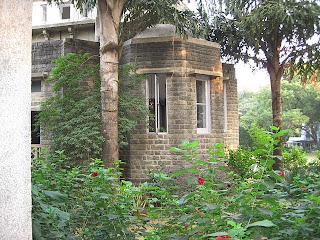
another view of the chapel

It sounds like there are many things going on here during the Lenten season, and I am sorry to miss them - talks, extra worship services, liturgy, communion, etc.  Church services here are an interesting mix of the liturgy I grew to love during my time attending Anglican communion services in Vancouver, Western praise songs new and old ("There is a Redeemer," "In Christ Alone"), Western traditional hymns, and songs I've never heard before and hope are of Indian Christian origin.  So it's been a fun mixture of new, old and familiar, and old yet changed in some way (e.g. new words to a familiar tune).  I am grateful it's the same God we worship no matter the place, language, or culture.

Saturday, February 13, 2010

jewelry

One of the interesting things I've learned a bit about since being here is jewelry.  Here are the tips:

1.  Women almost always wear earrings. They are usually gold, which none (yes, none) of mine are (I don't think I look good in gold, so I never buy it). So I just continue matching my earrings to the color I'm wearing instead of the culture. Yes, Deana, you can laugh at me.

2.  Only married women wear toe rings (read about it here - no idea how accurate this is, but it was interesting), and they wear (usually) matching ones on both feet.  I had to remove my one I got at Chincoteague probably 8-10 years ago and hadn't removed since to avoid confusing people.  I'm pretty sure my second toe on my right foot has an impression still.

3.  Women who are married wear a heavier gold necklace.  I have yet to distinguish this type of necklace from other gold necklaces commonly worn.  I don't wear a gold necklace (or any necklace at all) on a regular basis, so this one has not been an issue.

4.  I have never been a bracelet person.  However, I could definitely get used to bangles.  I wear them every day on my right wrist since I  have my watch on the left, whether or not I wear the silver ones I bought for myself or one of a few sets Nithya's aunt lent me.  I am getting attached to having slight tinkles happen whenever I move my hands.  They sell bangles in shelves of sets of 10 or so thin ones in all different colors or fewer thick ones. Some are glittery, others have inset shiny things.

attention

I was warned before coming here that I would get a lot of attention as a white, Western female in India.  I suppose I get some attention (i.e. staring), although it's mostly from small children, but it's certainly not what I expected after a total of ~8 past months in Latin America.  When adults here do look at me, they only watch until I am past and never (that I've noticed) turn their heads.  I also have not gotten any sound effects like the ones I encountered in Costa Rica and Honduras ("Ch-ch-ch," "Good morning, beautiful," "Hello, how are you?," whistling, etc.). 

I have mixed reactions to this.  It reminds me of my twin's reaction after her return from a semester in Costa Rica where she got lots of attention for simply walking down the street:  "Don't I look nice today or something?"  While I remember feeling fed up with the attention at times (can't I just get to my destination without attracting added attention that takes emotional energy even to ignore?), it is still a bit unexpected not to get attention like that at all.

The situation has also reminded me of other times/places in my life where I want attention and am ignored (e.g. the OR almost any time) or get attention I don't want (e.g. an attending's questions regarding a subject about which I remember little).  This was especially true last week when I felt fairly ignored by my team at the hospital.  It reminds me of how much I can come to depend on others' attention and affirmation for my worth.  It also reminds me of how the way I acknowledge or ignore others matters, both in what it communicates to them about their worth and in what the reactions it forms in me.  Do I really believe all other human beings I encounter are equally valuable because they are made in the image of God?  Or am I happier to encounter a western-looking one or one who speaks English or one who is kind to me or smiles back at me? 

The idea of facing someone reminds me of something I thought about a bit my senior year in college, partly due to help in conversations from an art major on my floor.  We talked about how part of art is the act of "beholding" the other, accepting who/what they are in order to portray it.  I remember thinking at that time about how part of my service in medicine can be a similar act of beholding a patient's illness/pain and not turn away.  I can choose not to be disgusted or discouraged, not to be overwhelmed by their suffering, but to offer the accompaniment of my presence and beholding in the midst of it.  I think God offers us a similar accompaniment, and one of my favorite portrayals of God's attention to us is the Old Testament idea of God's turning his face toward us, letting the light of his face shine upon us.  It is encouraging to me when I see clearly my own quick frustrations or impatience or self-absorption to remember that God is not surprised or disgusted by my sin but continues to turn his face towards me.  That is attention that matters.

Friday, February 12, 2010

update 2

I've forgotten to mention this, so I'll do it here.  Jet lag has been better for about five-six days now, so that is great.  I still wake up in the night, but it's more often due to dogs, music, or being hot/cold.  And I go back to sleep, so that is great!  :)

I am going in for a half-day tomorrow but otherwise am done with the explicitly pediatrics part of my rotation.  I really enjoyed it and saw some crazy stuff.  I definitely started to feel more like part of the team this week, although most of them still didn't talk to me that much...  My interns talked to me a bit more, and others would occasionally make an effort at teaching.  But one of them that I never felt like I connected with or was particularly warm to me told me to day that they would miss me when I leave.  So I guess they liked me after all!  :)

The rest of the Jefferson/South India crew is off to Bangalore this weekend, but I decided to stay home to read up on some of the stuff I'm seeing and still don't have any idea how to recognize/treat, catch up on some blogging on not just life details but what I'm thinking about, and just have some down time.  So if you have any specific questions on things I haven't mentioned, the next day or two would be a great time to email/comment them, and I'll try to get back to you promptly.

Wednesday, February 10, 2010

week 1

So, after spending 45 minutes trying to figure out how to get this computer to recognize my USB drive with pictures on it, I have given up and you will have to wait for pictures till I find a computer that recognizes it.  Sorry!

On to week one tally:

1 episode of spontaneous tears which I chalk up to a combination of jet lag and frustration at losing my entire team after returning from lunch break and having no idea where to look for them or who to find to understand that I am even looking for them.  This ended well in laughter and some Tamil learning with me sitting with the pediatrics librarian in her little room waiting for someone from my team to appear (eventually, someone did).
2 of the four of us got sick, one with gastroenteritis and one with a cold (not me at that time, although I have a cold now)
3 new salwar-kameez(es? - they look kind of like this, except the scarf [dupatta] is worn pulled forward about six inches lower) to wear for the first week and an additional four bought in Chennai this past weekend (on sale - two for the price of one! - the savings joy continues, even in India).  These are tailored to my personal measurements, supposedly, although my specifications for neckline so it doesn't feel like it's falling off my shoulders weren't attended to.  Ah, well.
4 of us fit into the back seat of a Toyota land cruiser (kind of like this?) for the three-hour trip to and from Chennai three times in the past eleven days
5 mosquito bites (despite dutiful application of mosquito repellent 1-2 times/day - no worries, Mom, I am trying to avoid all the mosquito-carried illnesses I see in the hospital)
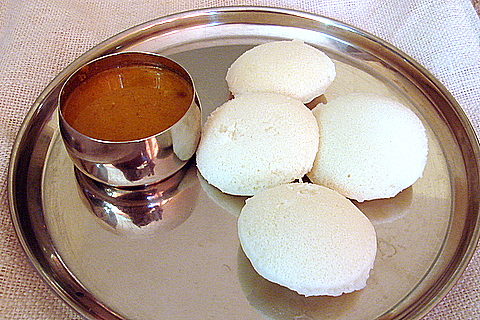
innumerable: dogs and cows in the streets, stars visible in the night sky over our campus in Vellore (I taught Thenu to recognize Orion!), idly eaten for breakfast already (rice-flour-like cakes that remind me of the Zambian nsima I will be eating in a few weeks that you eat with sauces like sambar served in little metal bowls like in the picture), water bottles consumed, times I wish I spoke Tamil or Telegu, or Bengali, or Hindi

Highlight of the week:  hearing the choir sing the Old Testament priestly blessing at the end of the church service last week.  The sound was nearly angellic.

Tuesday, February 9, 2010

first impressions

This is long overdue since I’ve been here a week and a half, but I wanted to share them anyway. :) I’ll do it in bullet form since that seems simplest for this sort of entry.

1. Seeing city lights from the sky through cloud cover is really gorgeous
2. Lights along the side of the road here are sometimes the long (3 feet?) fluorescent lights instead of the ones I typically see in the States. Why not?
3. Mattresses and pillows are really firm here. I may have to outgrow finally my bad habit of sleeping on my stomach.
4. I’m learning food names in a combination of Nithya’s Telegu and Thenu’s Tamil (gari = vari?). This can be confusing when trying to order.
5. Dipper baths with the option for hot water when heated by flipping a switch to turn on the water heater on the wall (with some patience) are quite refreshing. That said, not having a separate stall or tub for bathing take a little getting used to. Am I supposed to stand in the center of the bathroom or near one side? Does it matter how far from the drain I am?
6. Purchasing things is done very different here, whether it’s a salwar-kameez or my breakfast. You pay at one place, get a receipt, take the receipt to another window, and pick up the item there. When shopping, you may have to go to another place where your item will be bagged. I haven’t decided if this is faster/more efficient or not…
7. Crossing the street is an adventure. So is driving. Three vehicles across in a two-lane highway with auto rickshaws, cows, bicycles, cycle-driven carts, cow-pulled carts, etc. are commonplace. I’ve just decided in both to assume that we will all live to see another day and not to worry. After all, I’ve only seen one car hit a water buffalo crossing the road so far. And cars/trucks don’t really need much more than inches when passing other vehicles after all, do they?

I'll try to post again later after dinner.