Showing posts with label faith. Show all posts

Friday, April 6, 2012

travel

I recently came across the quote below in a book excerpt I was reading online.  Since I am spending this week on family vacation as a tourist, and I am then traveling to Ecuador for a month rotation at a mission hospital as a working visitor, thoughtfully comparing the two different types of visiting other locales seemed appropriate. I hope it also encourages me to reflect on how I choose to travel.

Mark Buchanan writes in Your Church is Too Safe:  
"[At some point,] we stopped calling people who went on trips travelers and started calling them tourists. Traveler literally means 'one who travails.' He labors, suffers, endures. A traveler—a travailer—gets impregnated with a new and strange reality, grows huge and awkward trying to carry it, and finally, in agony, births something new and beautiful. To get there, he immerses himself in a culture, learns the language and customs, lives with the locals, imitates the dress, eats what's set before him. He takes risks, some enormous, and makes sacrifices, some extravagant. He has tight scrapes and narrow escapes. He is gone a long time. If ever he returns, he returns forever altered ….

"A tourist, not so. Tourist means, literally, 'one who goes in circles.' He's just taking an exotic detour home. He's only passing through, sampling wares, acquiring souvenirs. He tastes more than eats what's put before him. He retreats each night to what's safe and familiar. He picks up a word here, a phrase there, but the language, and the world it's embedded in, remains opaque and cryptic, and vaguely menacing. He spectates and consumes. He returns to where he's come from with an album of photos, a few mementos, a cheap hat. He's happy to be back. He declares there's no place like home."


Moving from the relaxation of vacation with its reading, swimming, and playing games to the responsibility of caring for patients in my second language, writing medical notes in the chart and communicating on rounds in Spanish, and learning to treat tropical diseases rarely seen in the States is quite the shift.  Still, despite its necessary short-term nature (required in residency training programs nationwide), I definitely hope to create/continue patterns of traveling in the first way described. 

Indeed, I look forward to some of the changes.  I remember feeling in my semester in Costa Rica in college that Spanish was sometimes more my heart language than English; that I could say certain things better - more precisely - in Spanish; that I acquired an altered personality,  style of interaction, and linguistic prosody (the musicality of speech) when I switched to Spanish; that with my affectionate family, ability to tan, and short stature, I seemed to fit so naturally with Latin culture's demonstrative nature and its generally smaller, darker-skinned people.  I look forward to the chance to flip the coin (myself), to show this other side of me that always exists but now only shows in my much-enjoyed encounters with Spanish-speaking patients at work.

But I also have traveled enough to know that journeying brings its own challenges.  Flexibility is required of an international traveler, and this may not naturally jive well with my desire to plan out the details of my future.  Some cultural differences do not come naturally, and humility is an asset in evaluating the way that cultural differences compare to my home culture.  Loneliness can be a frequent companion separate from my usual surroundings of familiar friends, coworkers, family, and church.  Even the language switch, as fun as I find it, can demand enough mental effort to bring me to exhaustion by the end of the day, not to mention the challenges of a different medical environment.

 from:  http://my-bellavita.com/fine-print/adjusting-to-expat-life-in-italy-riding-out-the-culture-curve/

However, if Jesus is my ultimate example of one living a cross-cultural experience and dwelling with a people who are "other," surely I need to be willing to dwell where I am (even for a month) in a way that may cost me in order to love others well. It remains to be seen what this will look like, but I want to go into the experience willing to be flexible, to change the way I naturally or habitually do things, to form new friendships even if I am transient, to learn a language, culture, gestures, history, economy, and politics not my own. My hope is that through traveling and encountering people who are "other" and yet still God's children as much as I am, I may learn more of what it is to journey well through life, whether or not it gains me more stamps in my passport.


Sunday, March 25, 2012

frailty: gains and losses


 Working with the elderly gives a whole new definition and many, many faces to the idea of frailty.  Old age comes to all of us, of course (unless we die of something else first), and I knew intellectually that it often and eventually involved losses - loss of independence, loss of memory, loss of strength, loss of friends or family.  But it's one thing to know it in my head and another to encounter it in patient after patient, as I do on my geriatrics rotation.


One particular patient sticks with me.  She was an older woman with Parkinson's disease.  Most patients with Parkinson's develop dementia along with the physical neuromuscular parts of the disease.  She, however, had not.  She was fully aware that her body was no longer working as it should, that her face didn't move with its former expressivity, that her limbs were harder to move out of a single location than they used to be.  She felt like she was turning into stone.  She expressed regret for having walked regularly as a younger person to have a good heart given a family history of heart disease.  At this point, she said, she wished she did not have such a good heart.  Her grief at her losses was clearly apparent, and we were helpless beyond her current medications to do much to slow further losses.  (But telling the story and her words calls to mind this vision of Aslan blowing on stone statues and seeing them turn from cold gray to warm color and then regain progressive movement and function.  Maybe that's what heaven will be like for this woman.)   


The various Alzheimer's patients also stick with me.  Often unaware of their decline, they are at least spared the humiliation and frustration of the losses they experience.  However as an outside observer, it is sobering to remember that this sort of decline could and may happen to me some day years in the future.  I, too, may not recognize my spouse who lives in the dementia unit with me.  I, too, may be blissfully unaware of the fact that I am no longer a child who lives at home with her parents and that the stuffed animal I carry is not in fact a live pet.  The encounters can make for good stories, but the sobering reality is that these older adults have lost much of what I often think makes my life worthwhile.


It is not only losses, however, that old age brings.  I am reminded of this by looking at the old people in my own life, especially my grandparents.  It also brings wisdom and perspective, a patience born of seeing God's work and faithfulness over a lifetime.  It can carry the joy of family and grandchildren, celebrations of new life and the legacy represented in one's family.  It often provides time, time for worship and prayer, time for playing games with a spouse, time for enjoying old hobbies, time for volunteering or sharing with neighbors, time to catch up with family, time to make new friends and reconnect with old ones.


The whole thing reminds me of a passage in John 21, where Jesus goes to find his disciples after his resurrection.  They have gone back to their life before meeting him, fishing (albeit unsuccessfully) on the Sea of Galilee.  He miraculously provides them with an abundant catch and then feeds them on the beach, recalling their last meal with him before his death.  Afterwards, he takes Peter aside and asks him three times (recalling Peter's three denials) whether he loves him, questioning whether in the anguished aftermath of his betrayal (cf. Lk. 22:62) Peter has learned more of what it means to love and follow Jesus.  Peter insists that he does love him, and Jesus asks him to feed and care for his sheep, adding that when he is old, "you will stretch out your hands, and someone else will dress you and lead you where you do not want to go" (v. 18b).  The writer of John comments that this was meant to indicate the type of death Peter would suffer, arms stretched out on a cross upside down and led (tied) to a cross with cords of rope.


The passage illustrates Peter's transition from an easy commitment to loyalty in following Jesus to a deeper understanding of what a life lived in service to others (feed my sheep) and full surrender to Jesus' plan may mean (including a cross and going where one may not want to go).  It seems to me that this is part of the cost of growing old as well.  Increasing frailty requires a willingness to go where one doesn't want to go (sickness, dependence on others, admitting our vulnerability and mortality).  It requires an ongoing surrender to the plan of the Father and an increasing trust as our own lack of control becomes more and more evident.  Many of the older adults in my life have shown an ability to manage the changes of age gracefully, and I think part of the secret may lie in the overlap between the spiritual life's surrender and requisite admission of need for help and direction with the changes that the slowing down and weakening of one's physical body force upon us.  


In her book Revelations of a Single Woman, Connally Gilliam speaks about her fear of ending up a withered old woman as a result of not "getting it," questioning as a celibate single the role of sexual fulfillment in keeping one alive.  She found in the midst of her fears instead that it wasn't "what someone is not getting that matters, it's what he or she is giving" [of him- or herself].  The older adults in my life who most shine with life are not necessarily the ones with the best mobility or the sharpest memory or the most independence.  They are the ones who give of themselves unselfishly, sharing their stories and lessons and God's abiding presence.  They are the ones who teach me how to live and how to age and eventually how to die.  They are the living illustrations of how losing one's life may be the very best way of finding the life which is truly life.


Old Happy Man

Sunday, March 18, 2012

*hug*

Sometimes I feel like I blog about all the hard parts of medicine, the stories that wrench my heart and my struggles to know what to offer in the face of suffering.  Those people stay vividly with me, certainly, but they are not the sum total of my life in medicine.  It includes glimpses of loveliness and light as well as grief and regret.  This is a post to recount one of the former stories.

One particularly hard afternoon when I was on the inpatient (hospital) service a few months ago, I found myself in the ICU.  I had just been seeing one of the sadder patients on our service in the ICU, who was essentially paralyzed but totally conscious.  Our best medical treatments had done little for him, and he had little family or friends nearby and so had been paralyzed, awake, and on the ventilator alone without any visitors and unable to communicate for weeks.  I was feeling the weight of the sadness of his whole situation as I finished my note on his condition and began walking to the stairs to go see my next patient.

As I walked, I started hearing the strains of music.  I listened for a moment, thinking initially that someone had a radio running in a patient's room.  It sounded more like a hymn, however, so I moved towards it in curiosity and found an Amish family gathered around an ICU bed.  It appeared they had made the decision to withdraw care from a patient, although I don't know any of the story.  But as they stood with their community member in the patient's last hours or minutes, they were singing the old hymn, "Nearer, my God, to Thee," the notes of which I had heard.  

That stately old hymn always reminds me of the Titanic, where the ship's orchestra courageously played it as one last musical effort to bring comfort and hope to the ship's doomed passengers and crew in an irremediable situation as the ship sank.  Hearing the Amish family sing it with the understated beauty of a cappella harmony with their quiet dignity aroused much the same feeling of steadfast resolve and persistent faith.  This was especially true when sung surrounded by all the high-tech ICU interventions that often feel futile, the lonely suffering of the patient I had just left, the impending grief of their own family, and my own sense of helplessness.  I left the ICU and went to cry in the privacy of the stairwell with a sense of having been given a gift, a glimpse of the hope and faith when I most needed the reminder, a sense of being embraced and held.

I moved from the stairwell on to the next floor where I encountered a friend who graduated from this residency program last year and is now doing a fellowship.  She asked me how I was with some concern since I think the juxtaposition of the disparate experiences I had just had was written on my face.  I rarely see other residents or fellows/attendings in the hospital, so I stopped to process a bit, sharing with her the sense of darkness and hopelessness over my first patient and the shimmering light that felt like a candle in the darkness from the peace of the Amish family's faith.  She nodded and shared some of her own patient experiences and finally gave me a hug before we moved our separate ways.

Hugs are big in my family, I think an inheritance from my nana who believed everyone needs one (and probably more than one).  We give them when we first greet and when we say goodbye.  Many of my friends know me as the one who gives them hugs.  They are important to me, a needed source of support and a frequent gesture of affection.


               http://pocketcultures.com/2010/07/14/kiss-hug-or-shake-hands/

As I processed this experience with my spiritual director, I realized that I received two hugs that day.  When asked how I felt after the beauty of the hymn in the ICU, the word that came to mind was "embraced."  I think God knew, though, that I still needed human arms on the hug, so he put my path in line with that of my friend, and I had flesh-and-blood arms to offer me affection and sustenance as well.

I said at the beginning of the post that I sometimes feel like I post about all the hard things.  The same can sometimes be true of my life; I can focus too much on the painful things, neglecting or taking for granted the shafts of light and glimpses of beauty that cross my path in the midst of the suffering.  I have started seeing a spiritual director, and I think part of the purpose of spiritual direction is to help me pay attention to the beauty.

God is always at work - in my life as much as in the lives of my patients and others for whom I long to see his transforming power.  It's just a matter of learning to see, remembering to look, recognizing his voice.  Spiritual direction is setting time aside to look and listen.

Blogging performs much the same function for me, forcing me to look again at the stories of the people I encounter, to reflect on what the meaning of this sadness or that soaring hope is, and to look for where God is involved in it.  And in both, I have found, I am met.  Unobtrusively, quietly, usually unexpectedly, God shows up and is present and who I am and what I know and what I have learned at the end of the process is not the same as at the beginning.  In this, too, I am caught up and held, and I give thanks.  God is good.  E'en though it be a cross that raiseth me, still all my song shall be, nearer, my God, to thee.

perfection

written January-February 2012

http://www.preciouslife.com/?va=1&vc=279

A few months ago, I had my first prenatal patient deliver a baby with Down syndrome.  After a discussion of risks and benefits, this patient had elected not to do prenatal genetic screening, so the diagnosis of her newborn was a surprise to all of us after delivery.  I was surprised and then frustrated by my own reaction:  disappointment.  I found that I felt some obligation to deliver her a "perfect" baby and that I thought this baby didn't meet the criteria (whatever they are!).  And then I felt awful for feeling that, because I know personally several people with Down syndrome and they are wonderful people, full of dignity and life.  Even if they weren't wonderful people individually, however, I fully believe they share the worth that all of us have as humans, imperfect though we all are.

http://img2.allvoices.com/thumbs/image/609/480/78250276-downs-syndrome.jpg

As I was processing my reaction, I came across a Christianity Today article by Amy Julia Becker about her experience of having a child with Down syndrome, "My Perfect Child."  In it, she writes about the biblical concept of perfection where we are called to be perfect even as God is perfect:  "[T]his perfection has to do with becoming a certain type of person. It has to do with becoming the complete, whole, mature, full version of ourselves."  She then goes on to look at the Beatitudes' blessings as signs of what it means to be fully, perfectly human and concludes that it is "about meekness, sorrow, and longing for God...[about] understanding ourselves as creatures."  Through her experiences with her daughter with Down syndrome, she realized that despite our accomplishment-prizing culture, "a major aspect of recognizing my humanity meant recognizing that I am vulnerable, needy, dependent, and limited."

I think I have lost some of that realization, at least deep-down emotionally, and have begun thinking that the goal of "perfect" humanity is all the things our society - and my profession - values: achievement, financial success, high test scores, knowing all the right answers, solving all the problems (although I know we never can, especially the ones that matter most).  Somewhere along the way, I started thinking that these are the measure and goal of us as human beings, probably because I naturally do well at some of these things and so feel affirmed as a worthwhile person when I use them as a measure.  That too easily can lead to devaluing those who do not "measure up," like my new patient with Down syndrome.

What if being perfect means something different entirely, as Amy Julia Becker describes above?

http://laist.com/2007/08/26/dr_william_mobl.php

As I moved through Advent in December, I thought a lot about Jesus' voluntary giving up of power, honor, and knowledge to take on fragility, vulnerability, and human frailty and limitations as a baby.  I found (and find) myself struggling to transfer my treasuring of his action in history to then learning to value our human weaknesses, to recognize our creaturely identity (necessarily more limited than the Creator) as what it truly means to be human, and to grapple with what failures to measure up I should allow and even embrace with grace in myself and others.

If Jesus is the perfect Man, do I actually want to follow Him in his path of limitation and weakness?  Do I really desire to emulate his full submission to God, his giving over of control, as a model for what it means to be finally and fully human?  How can I give up my desire to control, to make everything "right" (in my narrow definition) in my own life and others' lives? How would life lived without that need for control look? 

I find that my perfectionism spills over even into how I see myself and my life lived before God, crippling my ability to trust and to live freely.  What if life were more about living it all before Jesus and for love of God in an atmosphere of grace and not so much about whether I meet the standard, hit the mark, or manage to avoid failing?

It reminds me of a comment by Henri Nouwen about forgiveness where he explains it is "allowing the other not to be God" and thus not to be omniscient and perfect.  My perfectionism - requiring, demanding no mistakes of myself; having high expectations for others - has many more reinforcements in our society and my profession, but I am struggling to remember to let myself and those around me be what they are - creatures.  Flawed and imperfect, wondrous and lovable, miracles even when they require that we change our expectations.  I'm learning to love a certain little miraculous baby with a recognizable face in the process.

 http://liveaction.org/blog/a-world-without-people-with-down-syndrome-at-what-cost/down-syndrome-child-1/

Wednesday, January 11, 2012

stories 3

(see previous posts for 1 and 2)

from 11/2011:

I cried at work today.  I was working on the discharge of a 45-year-old woman admitted with intractable nausea and vomiting who was found during the admission to have brain metastases (spread) with a lung cancer as the primary tumor (origin).  She was talking about how she had hoped to go back to school to show her kids that you can do anything you dream of if you work hard enough for it.  She spoke of going back to work to provide for her family, including her youngest child who is eight years old.  I thought silently of how with her advanced disease I was pretty sure she won't make it to her 9-year-old's elementary graduation, let alone his high school, short of a miracle.  But I didn't say that.  Instead, I said, Take lots of pictures.  Work on spending as much time as you can in the short term with family as you learn more about and adjust to your new diagnosis, as you figure out what is going to be realistic in the days and weeks ahead.  She nodded.  Coming out of the room, I stood at the chart to write up the discharge orders and tried to hold myself together as I thought about her situation.  Instead, the tears slipped out as I silently grieved her losses - dreams, plans, time with family - until the nurse came up to make sure I didn't need anything further, and I wiped my eyes and wrote the orders for her to go home.

As the second year on ward, I see patients of our residents and faculty who are admitted to other services who need "medical management" for which we follow them while they are in the hospital.  Usually this means controlling their blood pressure or blood sugars, but it meant a lot more for one 25 year old woman for whom we were consulted to help deal with her anxiety and depression.  I stopped by to see her after rounds, so I had more time than the usual half-frenetic rush through the assigned patients before rounds.  I spent the next 1.5 hours of a thankfully slow day hearing her tragic history of abuse as a child; rape as a teenager; and physical, emotional, and sexual abuse by her first husband.  She now deals with so much anxiety that she literally can't even get out the front door to go see her mother down the street, her only real source of support, without first fortifying herself with anxiety medicines. 

"I have no friends," she said.  "I know people say that they have no one, but they always have someone.  I don't.  I have no one."  And I believe her as she recounts her story of being imprisoned in her own house by the wounds of her past experiences, trapped in unhealthy patterns and relationships.  I sat there on the foot of her bed and patted her foot as she cried in despair, and I prayed.  Her emptiness reminded me of an article I read a few years back on having nothing and emptiness and how God can work with that.  So I prayed and I pray that like the widow in 2 Kings 4 with her empty jars that this woman would come to the place of giving her emptiness to the One who can fill it to overflowing.  I have nothing better to offer.

Another patient I saw recently is a 35 year old female who told me in the course of her appointment about her home situation.  She wants out of her relationship with her husband who is having a long-term affair but feels trapped since due to her own health problems she has no way to provide for their six children.  She tells me about how she knew about her husband's girlfriend even before she became pregnant with their youngest child, and I wonder what she sees when she looks at herself in the mirror.  My heart longs for more for her - she is worth so much more - and I could hear the longing as she told her story, too.  But she can't see a way out, a way to live differently. 
 

So often when I am faced with patients' pain, I wish I were artistically gifted or somehow able to use my word to paint a different picture for them.  I want to show them another way of living, a way that life can be full of meaning and substance and, yes, even joy.  It is a different way of envisioning what it means to be human and what their lives are meant for - so much more than infidelity, abuse, and broken dreams.  They and you and I were made for relationships characterized by love and faithfulness, for learning to move past conflict to forgiveness and past broken pasts to restoration, for trusting the Dreamer's visions for us even when it means opening our hands to let the pieces of our plans fall through our fingers.  It is my hope and prayer that in my life and actions and sometimes even in words I can communicate to the broken people around me a new vision, a tapestry of what life can be, one aglow with the light and love of the One who makes our lives worthwhile, tinged at the edges with hope, and woven through with growing, stabilizing strands of healing.
These pictures by local Lancaster artist Liz Hess were done to portray the Exodus story for an African context, bearing witness to the truth of the story for all peoples.  The sense of release from oppression and joyous abandon in coming home that they so clearly portray is the same feeling I long to be present in the lives with which I come in contact.

Friday, October 14, 2011

life. breath. breathe.

Life is fragile.  Nowhere, perhaps, is that more apparent than obstetrics.  We so closely monitor these tiny lives dependent on their mother from months before viability up to and after delivery where we marvel at tiny fingers and toes complete with nails, the rosebud mouth, the blinking eyes, the soft spot. 


I'm on nursery this month, and I've seen a lot of newborns.  I also hear the OB signout in the morning since knowing what is going on with laboring moms will mean I know what to look for in the babies.  We've had a rash of high-risk, sad cases, though, and the fact that I never see the moms I hear about in signout reinforces my feeling of helplessness in the face of the tragedy down the hallway and yet completely out of my reach even to comfort. 

Perhaps the most dramatic example was a patient that came in with headaches and high blood pressure.  She didn't know she was pregnant despite being about 20 weeks and carrying (surprise!) twins.  Her severe and worsening preeclampsia, however, meant that it was a choice between losing three lives and losing two.  So a C-section was performed, and mom was closely monitored afterwards for her dangerously high blood pressures and risk of seizures, liver damage, and kidney damage.  Her babies died two hours after birth, unable to survive outside the womb at such severe prematurity.  I can't imagine the rollercoaster of emotions she has been on - feeling sick to discovering she is pregnant to learning she will lose the babies to watching the babies die to dangerously ill herself.  It makes me remember, too, the 19-week infant I held in my hands and watched die after a mother miscarried in Zambia. 

Another patient came in having broken her water ("ruptured membranes," as we say) at 20 weeks, nearly a month before viability when her baby could survive outside the womb.  She is at risk for infections without the membranes to keep bacteria out of the uterus, and the baby is at risk for separation of the placenta from the uterus without the fluid to keep it pushed up against and keep the uterus inflated, so to speak.  Her cervix is partially dilated, and the ultrasound showed the baby's feet moving in and out of the cervix with movements.  So close.  So close to life.  So close to death.  A few more weeks, and he or she might have a chance.  She was offered the possibility of delivery now since she has less than 1-3% chance of reaching 24 weeks without spontaneously delivering or getting an infection, but she chose to wait.  So here she is in the hospital, waiting. 

A similar patient who broke her water at 32 weeks waited for a week and a half before starting labor spontaneously and still ended up with a C-section when the baby wasn't doing well.  Her baby is still in the NICU a few weeks later.  She comes in to see him and is attempting to breastfeed.

But it's not just large things, dramatic cases that tear at my heart when I hear the details.  It's little things, too.  A baby's hearing screen comes up abnormal, and I feel for the parent who suddenly faces the possibility of life with a disabled child.  The baby looks perfect, but so much of this whole parenting and doctoring thing is beyond what we can see and control.  (A repeat hearing test ended up being normal, so fears were alleviated this time.)  Another infant has a low temperature overnight, prompting a workup for infection.  Again, the baby looks fine, has been feeding well and is active and vigorous, but I worry.  Am I missing something?  The stakes are so high.  These little lives are so fragile, and I know from the stories that things can go downhill quickly.

There are good experiences, too.  I went in a C-section and got to suction the (crying - yay! never are we so happy to hear a crying baby as at delivery) baby and learned to remove the placenta.  I am doing circumcisions under supervision and feeling more comfortable doing this relatively simple procedure and feeling happy with the results.  One of our babies was crying in the nursery one time when I was there waiting for something.  I picked him up, and he instantly stopped crying.  Gratifying - but again a reminder of how dependent these tiny people are on us older ones. 

The Bible connects the idea of life and breath, starting way back in Genesis when God breathes his breath into us, the breath of life, and humankind lives first in Adam and then also in Eve.  The promised new life as the people of God in the New Testament is also connected with breath, with God's Breath, his Spirit (same word in Greek pneuma and Hebrew ruah).  It makes sense; the last thing you see someone do when they die (naturally) is to breathe out. 


It reminds me of another image, that of vapor.  In Ecclesiastes, the writer reports that life is "meaningless."  I remember learning in my college Old Testament class that the word translated "meaningless" is hevel.  This is a word used to describe vapors, such as the early morning fog that would cover Jerusalem that would disappear nearly before the eyes of those who lived there as the sun rose.  As such, it communicates transience, the ephemeral nature of life. 

But the word has another meaning.  It is also used of breath, this invisible movement of air that enables us to live our lives, to laugh, to cry, to speak, to love, to worship.  The truth, I think - and what I am sensing in the vulnerable small lives I hold in my hands each morning as I round - is in this tension.  Life is temporary and fragile and yet it is beautiful and meaningful, full of significance and closer to its end than we like to think, as close as your next breath or mine.  I am relieved to remember that the balance is not in my faulty hands but in the love-marked hands on which our names are engraved so that we know he will never forget us.

                                      morning mist in modern-day Jerusalem

Monday, September 19, 2011

lessons from a relationship

I recently began a new relationship.  As is a new relationship's wont, it has been much on my mind.  This post goes through some of the things I have reflected upon as we have moved through the initial weeks of getting to know one another, particularly as it relates to the faith relationship I have with God.

I am struck by how much of the relationship itself consists in waiting.  We date because we don't know whether this will work out in the end, so we're waiting on a final verdict from one or both of us on the relationship itself.  Traditional in some ways at least, I (usually) wait for him to call.  We wait for the next step in the relationship itself as we gradually get to know each other better and so move to different levels of sharing.  But don't get me wrong.  Despite all the waiting inherent in this process, I am definitely enjoying the process itself!  It's just that it has struck me repeatedly that a relationship is just this:  something already but still a process of becoming what it will be.

Waiting in the context of a relationship recalls to mind the already/not yet tension present in the way Scripture talks about the Kingdom of God and Jesus' present reign on earth.  In some ways, it is already here, changing lives, working powerfully in this world, but in other, significant and substantive ways we still wait for the already-won Kingdom to be made manifest in our lives and this world.  We wait for the fuller, deeper thing even while we enjoy the very good thing we already have and glimpses in what we have of what is to come.  In this hurting yet wonder-full world and my fun yet becoming relationship, we wait, in hope.

I have been struck as well by the vulnerability that arises in me through this relationship.  I am used to being what I have been for most of my adult life:  basically an independent person.  Instead, suddenly my whole day's outlook can be changed dramatically by this single other person - whether he calls or not, what he says in an email, an unexpected letter, etc.  Just thinking of him brings a smile to my face, and my friends' teasing easily makes me blush.

So far the vulnerability has brought all good things; the cloud of euphoria that accompanies the early phase of a relationship makes me a very happy person!  But I know the power is there as well for one of us to hurt or disappoint the other, for careless words to wound, for lack of contact to inspire a loneliness I wouldn't have felt so keenly a few months ago.  It's a power that's scary to acknowledge in myself as well since both of our (not just mine) investment in the relationship and each other brings this vulnerability to the other.  It's a risk I take, acknowledging it as part of the necessary process of a relationship, but it's not one I take lightly for either of us.  It's helpful on my end to remember the trust I am forming through experience in the character of my boyfriend (and to work on making choices that form me into a person of character worthy of trust).  It is good, too, to remember other influences on my well-being - the stable, unchanging love of the Father who calls me beloved (this music video recently made me cry); the family who loves me wherever I choose to go and whatever choices I make; the friends who so willingly rejoice with me.

The next theme of my reflection has been on the idea of hope.  Two months ago, I didn't know this guy existed.  Now, my life has changed dramatically in the space of days and weeks to reflect his existence - how I spend my free time, where my thoughts are, even how I relate to others.  It's a simple but powerful reminder of how much a relationship can change us. May my relationship with Jesus affect me as much!

In Hebraic thinking, our "heart" was much more than our emotions; it also was the locus of the will and in some ways encompassed the orientation of the whole person him- or herself.  Thus, out of our hearts flow our actions, our priorities (cf. Mt. 6:21), our thoughts.  It makes me reflect carefully about where I am turning my heart, which leads me to my next thought.

I have been humbled in entering this relationship by the whole comparison of this earthly early care to my love for and relationship with God.  I am struck by how quickly my thoughts go to him, how naturally I delight in spending time with him, how easily my joy and excitement overflow into sharing about him with others.  Would that I had the same thoughtless, carefree joy and delight in my relationship with God!  How might others respond if I as easily began talking excitedly about God as I do about my last weekend?  Would they be drawn to Him when they see the glow he puts on my face?  How often do I consider Jesus' reactions to my day, ways to integrate him into the interactions I have, regular sharing of my thoughts and emotions for the sake of having another reflect on them to me, perhaps gently pointing out where I fall short of Jesus' example? 

I am sure there will be more lessons along the way, as there can be in any relationship but most strongly in the commitments where we make ourselves vulnerable.  But for now, I'm enjoying the process and learning to wait, seeking to learn to live responsibly with both my own power and vulnerability in this new context, and aiming to orient my life - this relationship included - around the one Romance that can define and transform me in ways that prepare me to live all other parts of my life.  May my love for Him grow and overflow in joyous abandonment that draws those around me to and reminds me of the worth of (as Chesterton put it in Orthodoxy) this lived Romance, a combination of strange and secure, wonder and welcome, happiness in this "wonderland" without "once being merely comfortable."

Thursday, September 15, 2011

senses - hearing/sight

I'm on an ENT (ear, nose, and throat) and ophthalmology (eyes) rotation right now, so I've been doing some thinking about the senses we often take for granted when they work well.  That is, I was until this week on night float.  But we have a slower week so far, so hence the nighttime blog posts.  :)

Seeing
One of my favorite things about ophthalmology has been the simple process of seeing people's eyes being illuminated by the light as the ophthalmologist examines them.  The lamp and microscope move in front of their eyes and, at an angle as the ophthalmologist looks at the retina (back of the eye), the light reflects off the whole iris (colored part) in the darkened room, giving the patient these beautifully shining lit-up eyes that reminds me every time of the quote about the eyes being the window to the soul.  I am struck by the scene's beauty all the more for the fact that the patient can't see it.  Here's this beautifully illumined eye in all its unnoticed complexity, and they have no idea.

  http://mychinaconnection.com/wp-content/uploads/2010/12/see-eye-to-eye.jpg

Hearing
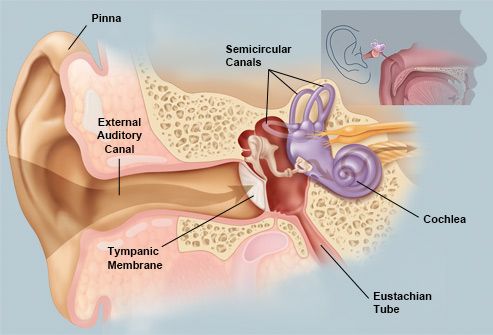
Hearing, too, is affected by things we can't see or access.  Even common wax can obstruct one's hearing without the patient knowing what it is that makes them hear less on that side (or both sides).  The inner ear itself, where the tiny middle ear bones transmit sound waves made into vibrations that are picked up by microscopic hair cells, is beyond visualization even for the ENT doctor.  It can be seen somewhat on a head CT in large scale but the hair cells that may not work as well for hearing as one ages or whose disruption with tiny stones (otoliths) can cause lifestyle-handicapping vertigo (dizziness) are beyond what we can easily access. 

                        http://www.webmd.com/brain/picture-of-the-ear

Hearing and Seeing
In a recent conversation, I was asked which sense I would rather lose - sight or hearing?  A difficult question to answer, and one that prompted a quick evaluation of all the taken-for-granted ways these senses affect my life.  The crescendo of a piano piece or the steady patter of raindrops.  A glorious nearly-neon sunset or the color of sunlight through a leaf.  Hearing someone call my name as I walk down the hall.  Seeing the identity of the speaker or identifying them by their voice. 

Sight and hearing are linked in another way.  Both senses require two steps to achieve the appropriate perception of sound/vision.  First, the external stimulus must be perceived - cells in the retina send off signals from the eye; those hair cells from the inner ear do the same after the vibrations reach them from the bones of the middle ear.  Second, the message received in the brain must be processed appropriately for it to give us the right picture or sound.  One needs both steps to actually achieve sight or hearing that is meaningful. 

The Bible understands the importance of both of these steps, too.  God's judgment on his people when he sends them the prophet Isaiah is:  "Be ever hearing, but never understanding; be ever seeing, but never perceiving...Otherwise they might see with their eyes, hear with their ears, understand with their hearts, and turn and be healed" (6:9b-10).  This is picked up in the New Testament in Matthew 13 (as well as parallel passages in Mark 4 and Luke 8) when Jesus understands why he speaks in parables, telling stories to communicate truth to those whose ears are open and whose eyes see clearly and concealing it from those who don't. 

My experiences on ENT and ophtho make me wonder: 
1.)  What sort of unseen blockages keep me from hearing God's voice clearly?  Pride.  Busyness.  Independence.  For many patients with wax in their ears, simple daily administration of a few drops of oil can help keep the wax soft enough to move out.  What similarly mundane practices can help my ears stay open?  Daily prayer.  Meditation.  Time in nature.  Time to listen.  Cultivating the practice of listening in my relationships.  Obedience when I do hear God's direction.
2.)  What overlooked glorious beauty and light is shining around me?  A simple mirror would enable the patients being examined to see the light illuminating their eyes.  How can I be a mirror to others, reflecting the Lord's light to them?  How can I be more attentive to God's presence and work in my own life? 

              http://stevetallamy.com/wp-content/uploads/2011/04/Seeing-Beauty.jpg

Monday, August 22, 2011

stories 2

Before I start with the stories (altered, of course to preserve patients' privacy), I want to review the reasons I share them.  First, it gives me an outlet for processing and sharing the patients whose stories stay with me.  Second, it ensures in some way that I will not forget or grow numb in the busy succession of appointments and rounding.  Third, it forces me to stop and remember that each patient I encounter is first a person - a real embodied life whose body has a problem that leads to their encounter with me.  It encourages me to stop and look the person in the face, so to speak, encountering them as a human being as I review their story with you.  May it remind you in whatever your field is to do the same.

I saw my first rape survivor recently in clinic.  A 14 year old who was violated several weeks ago is now sitting withdrawn and quiet in the chair.  So withdrawn and quiet I had trouble feeling that my compassion and regret for her situation could seep in past the shell she had put up.  I felt very helpless, unable to reach her to comfort or support her, the protective barrier she had erected keeping out those intending her good as well as evil.  It is hard not to feel hopeless in these situations as well.  A friend's prayer as I shared my dismay over the whole situation reminded me that I am not ultimately powerless.  I can still pray that God reaches past her brittle shell and embraces her, enabling her to heal and grow past and despite this and not to get mired, stunted, in the pain and vulnerability. 

The next patient snapshot was a 26 year old G4P2012 (4th pregnancy, two living children, one abortion) at 8 weeks by her last period.  She had bleeding yesterday and went to a different ER where an intrauterine pregnancy was visualized.  She now is here for re-evaluation.  Ultrasound shows an empty uterus after she passed clots all day yesterday, and the baby's hormone (beta-hCG) level is dropping quickly.  The intern I am working with asks her after we give her the news, "How are you doing?"  And we watch her face crumple before she covers it with her hands.  Her sister, sitting with her, also tears up but doesn't move to offer comfort, so I move to the bed and put my arm over her shoulders and one hand over her hand on her belly and rock her, praying for her to somehow find peace in the midst of this disappointment as I hold her. 

The final patient whose story struck me was a 55 year old woman who cried through most of her visit as she told me of her history of physical, emotional, and verbal abuse in her 30-year marraige.  She shared how she finally left him after being really beat up one time about a year ago and of the ongoing abuse she endured at court appointments to get her support from him after their divorce.  I admire her courage for finally getting out safely (since the most dangerous time for an abuse survivor is when she decides to leave) while simultaneously wondering how she will ever heal from all those years of fear and betrayal.

Sometimes I marvel at all the pain people carry, wishing I had a sponge to sop it all up, leaving these lives I encounter a bit lighter, less weighed down with their wounds and worries.  I am reminded instead of something Stanley Hauerwas writes in his book, God, Medicine, and Suffering, "I cannot promise readers consolation, but only as honest an account as I can give of why we cannot afford to give ourselves explanations for evil when what is required is a community capable of absorbing our grief."  In other words, what we often need is not an answer to our anguished Why? so much as someone willing to comfort and walk alongside us in the silent space of isolation that suffering produces. 

In my words and actions, I seek in small ways to be part of a community capable of absorbing some of the grief I behold (see more on beholding in this blog post more than a year ago).  In my silent prayers for these women, I seek to bring them before a Community truly able to absorb their grief - the Father who can hold them, the Brother who intimately knows what it is to suffer and shares in their pain, the Spirit who groans their hearts' cries with emotion beyond what words can express to the throne of the Lord of the universe when they do not even know how to pray.  As Sarah Lance said in a quote I have across my computer screen daily, "I have the rare opportunity to share the hope of being found, known, loved, celebrated, forgiven and treasured by the God of the universe. This is my only answer for suffering."  May these hurting lives I encounter also have a chance some day to encounter that hope.

Tuesday, June 28, 2011

held

So I haven't blogged for a while, partly because I feel like I've had a ridiculously busy series of months through the late spring and partly because I haven't felt like I had anything to blog about.  I felt fairly emotionally burnt out for a number of weeks in April and May, and nothing really stood out to me.  I'm feeling better overall, but nothing struck me until I was reading the list of vital signs on pediatrics the other day.

The vitals come in a list with different headings:  blood pressure, heart rate, respiratory rate, pulse ox, etc.  But what caught my eye wasn't one of the numbers or its heading.  It was one of the entries under the heading "position," usually used to indicate sitting/standing/lying.  Since I am on pediatrics, however, this entry read a single word:  Held.


Such a powerful word.  In one syllable, it brings to mind images of a mother tenderly cradling her sleeping infant, a husband embracing his grieving wife at a graveside, a father catching up a child that runs to him to throw her in the air and catch her close.  It evokes the idea of security, of being valued and protected, of love and affection.  It reminds me, too, of the Natalie Grant song "Held" which explores the ways in which God is present for us, holding us, in the midst of life's trials and suffering.

Much of what makes me feel burned out are the things I carry with me - my own insecurities and shortcomings, my friends' or family's struggles or disappointments, my patients' suffering, pain, and resignation to the way their lives are that in so many ways fall short of what God intended (relationships, health, sex, loneliness, etc.).  What if I can find a way to let all I carry - and myself, too - be held by the Father, the weight of it all still there (because it is real) but no longer borne by me, no longer heavy on my shoulders?  If it takes feeling people's pain to learn to recognize his steady embrace, that's a price I'd gladly pay.  Because I do trust that whether or not I feel it, his arms carry me secure.  And maybe then I can invite others and their pain that so moves me into the strong love of the Father where they, too, can know what it is to be held.

Wednesday, March 9, 2011

trafficking, shame, and freedom

Human trafficking is an issue that has come up recently in efforts to raise awareness - yes, even here in rural southeastern Pennsylvania.  A quick search of related websites indicates probably 27-30 million people under modern-day slavery, forced to work or be a child soldier or a prostitute often in a place where they don't speak the language.  It's an ugly issue, one nearly overwhelming with the myriad of stories of abuse and rape and shattered lives.  And yet it is one where I as a person in medicine have the possibility of playing an important role in recognizing victims.  Look beneath the surface, the presenters urge.  Look for the signs that might indicate a powerless person with no control over their employment, income, place to stay.  And the corollary:  Be willing to help.

It reminds me somewhat of child abuse.  Physicians are always obligated to report suspected child abuse, even if they are not sure.  The investigation is out of our hands, but the error must always be on the side of protecting a helpless victim.  This feels similar - the obligation to help, to know what resources are available - with the added complication that this is sometimes an adult, so how do I offer help in a recognizable form to someone used to betrayal?

Perhaps the most important step starts with the step illustrated by this Ten Shekel Shirt song, "Fragile:" http://tenshekelshirt.com/.  "It's Not Your Fault."  The people who came and spoke at my church about their work among former victims of trafficking told stories of seeing new life come when women began to find forgiveness for themselves.  Often their own way of seeing themselves kept them in captivity.  But they have found a way out of that crippling shame through Jesus, and it transforms their lives.

Shame is not limited to victims of human trafficking, however.  It is found as well in the physician addict who secretly shoots up opiates scavenged from the ER sharps box.  It is found in the young man with hallucinations who can't seem to escape the clamor of voices inside his head.  It is found in the survivor of domestic violence who goes back once again to the abuser, hoping against hope that this time will be different.  It is found in my own heart with my struggles and failures.

I read a book once that spoke of shame, saying, "Shame enters in and makes its crippling home deep within our hearts.  Shame is what makes us look away, so we avoid eye contact with strangers and friends…  We know we are not all that we long to be, all that God longs for us to be, but instead of coming up for grace-filled air and asking God what he thinks of us, shame keeps us pinned down and gasping, believing that we deserve to suffocate... Shame causes us to hide.  We are afraid of being truly seen, and so we hide our truest selves and offer only what we believe is wanted."

I think of that image often as I interact with the hurting people that cross my path, their regrets and disappointments combining nearly to suffocate them.  I think of it today, Ash Wednesday, as I think about the vast heart difference between shame and repentance (which is the season of preparation for Easter that Ash Wednesday initiates).  One leads to that crippling sense of suffocation; the other leads to walking head up and eyes on Him in freedom and life.  As the Anglican liturgy says, 

"Praise to you, O Christ, King of eternal glory.
The Lord is a great God, O that today you would listen to his voice.
Harden not your hearts." cf. Psalm 95.3, 8 

"Remember that you are dust, and to dust you shall return.  Turn away from sin and be faithful to Christ," the priest reminds as he puts the black powder of the ashes of last year's Palm Sunday fronds on our foreheads.  It is a reminder of our fragility and our mortality, a truth I see daily in my work.  But more, it is a reminder that out of death we, like all in slavery - physical or spiritual, are called to life, out of binding shame to joy overflowing, out of sin through repentance to holiness and wholeness.  Harden not your hearts...

Saturday, February 19, 2011

trusting the process?

12/23/10 (the thoughts started then, but I am finishing the actual writing much later)

I am completing my second rotation on obstetrics, and the idea of trusting the process keeps coming up.  It comes up related to residency most of all, as I anticipate completing my intern-year coverage of OB and have to trust that I will learn all that I need to know as an upper-year by the end of these four short weeks.  Will I make wise decisions without someone farther ahead off of whom to bounce ideas for evaluation and management of our patients' different complaints?  Will my fingers learn the tasks of the examinations needed, the suturing, the positioning of a baby's head?  Trust that those who have gone before you and learned what they need to know through this training process know what they're doing when they tell you that you, too, will learn what you need to know, I hear again and again in different words related to different topics.

I think about trusting the process for labor itself.  Most patients don't know the different stages of labor (latent, active) let alone the cardinal movements a baby's head makes just before it's born.  They can't read the fetal monitoring strips we look over every time we enter the room, and they don't know how many contractions in ten minutes constitutes "adequate" labor.  They are forced to trust that their bodies know what they're doing, that the pain they endure will be worth it in the end, that their baby is slowly moving towards entering the world long before they can see or feel anything but the tightening of contractions.  It takes a marvelous amount of trust in something we in medicine still don't even entirely understand.  We don't know what hormone or protein makes labor start or where that stimulus comes from.  We don't know why labor starts when it does, sometimes weeks before and other times days or a week after the due date.  But this is how little human beings have been entering the world for thousands of years, and somehow it does work much of the time without any help from medicines or monitors.

The season, too, reminds me to trust the process as we move into and through Advent.  We who believe trust that the One who came as a helpless baby will one day come again as One to reign and set things right.  We can't see that day approaching.  The Old Testament prophets and New Testament writers thought it would be much more immediate than it has been over the hundreds of years since that first Coming.  But we remember that fact that He came and trust this process of labor and birth as well, trust that sight unseen He is making His way towards Coming Again.

In my own individual life, too, I must trust the process.  Am I becoming someone I want to be?  Am I in fact growing as a human being - in character, in strength, in faith?  Moving in a direction towards God?  Or am I becoming stagnant?  Is the Spirit still invested enough in my life to be spurring preparation for new branches and buds?  I am called to trust as I surrender myself, seeking God's way for me to live my life, at peace with the work He is doing at His pace.  I am called to trust in the One "who began a good work" in me and "will carry it on to completion until the day of Christ Jesus," as Paul wrote to the Philippians (1:6b).  That's a process where it is worth seeing the end, and it gives me hope for these other places where I trust that God is also at work, bringing new life, helping me grow as a doctor, preparing for his Return.

Monday, November 8, 2010

struggles

It was my first time seeing her, and a long conversation about what to do with her conflicting feelings over an unplanned pregnancy was not what I expected to encounter upon entering the room.  She'd been pregnant half a dozen times before, but a combination of repeated first-trimester miscarriages and third-trimester losses meant she had only two living children.  Just hearing her story of waking up several weeks prior to full-term in a pool of blood and then delivering a dead baby was enough to make me want to cry for her.  A history of childhood abuse and adult rape only increased my admiration for the courage that made her able to continue dreaming for her future.

But this was an office visit with limited time, so I avoided tears on her behalf as I heard her stories and brought the conversation back to the issue at hand - her current pregnancy.  Due to serious health problems and a history of complicated, high-risk pregnancies, she was unsure that she should carry this pregnancy if she wanted her living children to have a mother with whom to grow up.  She cried to me - a near stranger - over her agony of deciding she must end the pregnancy.  We spoke of options, and I affirmed our support for her medically and emotionally whichever option she chose.

The encounter reminded me of the confusing way my roles and identities intersect as I start the practice of medicine.  I believe strongly that my primary interface in any interaction is that of one human being encountering another.  But as she spoke of the recommendations health care workers have made to her in the past and of her feeling that the only responsible path was to end the pregnancy, I was reminded that as a doctor I may still be a human being, but I am also more alongside that.

I am a person with power in this relationship.  I feel it weigh on my shoulders as patients ask me questions.  It is power to influence.  Power to persuade or recommend.  Power to change her mind...  Or power to give away to empower another.

How do I deal responsibly with that power?  How do I balance my own values as a human being with the inequality of our status in this relationship and my own deep desire not to push my beliefs on someone else?  How do I reckon with the fact that I as a human being am accountable for my own choice to influence - or not - in one direction or another while also seeking to let my patient be responsible for her own choices?  How do we ever persuade wholeheartedly while avoiding manipulation?  How do I take off this cloak of authority and seek to relate on a level as one person, one woman, to another?

All of these questions hung on my heart, grabbing my attention and shaping the way I spoke and responded as I spoke with my patient.  And all of them remained as I wrote my note on our visit together through my tears.  I shared this story at a medical conference seminar on reflective writing recently.  One of the comments I got in response was from a fellow believer: "You very much nailed the tension of living out our faith in a power relationship but love always wins."

Love always wins.   What does that look like?  I'm not sure in the day-to-day whether I make the right choices.  But it is a relief to be reminded that at the end of the day - whether I agree or disagree with my patients' choices, whether I have complete peace with what I said and left unsaid - if I have loved them, I have done what is pleasing to God.  And all the best advice and soundest options counseling without love would be worth nothing.  Now for learning the wisdom of figuring out when love looks like emotional support and when it requires hard conversations...or maybe it's both.

Friday, October 8, 2010

breathing

started to be written in early September 2010:

I just finished my surgery rotation.  As part of the rotation, we spend a few mornings with anesthesiologists doing intubations, practicing breathing for people with the bag-mask, etc.  It is common practice after someone is asleep/unconscious to breathe (ventilate) for them using the bag and mask for a little while so that their lungs fill up with oxygen for the body to use while they are not breathing temporarily during the actual process of putting the breathing tube in place (intubation).  It struck me watching the bag-mask ventilation how intimate a process this is.  It's not mouth-to-mouth resuscitation, but the motion of my right hand pressing the bag to push air into the mask and my other hand holding up the chin to open up the airway for the air to pass through is strikingly crucial for the patient who is asleep.

I am reminded in thinking about breath and the life to which it connects us of how often that image comes up in the Bible.  It is there in the very beginning as God breathes his breath of life into the human being, "and the man became a living being" (Gen. 2:7).  It is the promise of God to his people as they wait in exile, feeling dead and disassembled like a pile of dry bones without the breath of life to hold them together and give them purpose:  "I will put breath in you, and you will come to life" (Eze 37:4-6).  It is there when Jesus speaks to the startled, uncertain disciples after his resurrection, breathing on them and giving them the Holy Spirit (Breath) along with his peace and his commission (Jn. 20:21-23). 

That final image always reminds me of the way C.S. Lewis picks up the image of God breathing on us in the Chronicles of Narnia.  He pictures the great Lion Aslan breathing new life and courage and vision into his children.  Aslan breathes onto Lucy to help her meet the challenge of doing right alone.  He breathes onto the cold stone statues of the Witch's courtyards, bringing them to radiant life.

The word in both Hebrew (ruah) and Greek (pneuma) for spirit and breath/wind are the same.  Thus, the promise of God's Spirit to live in his people is a promise for his breath, his life, to live in us, enabling us to live the life we were made to live.  It is God's promise that he will pour out his Spirit on all people, Jews and Greeks (Acts 2:17).  It is his Breath in us that is our deposit of salvation, a guarantee of our inheritance (Eph. 1:13-14). 

So as I have the precious and uncommon opportunity to breathe temporarily for others, I think about the breath I myself breathe.  I think about the life I live and the possibility that I have to live out God's life, his Spirit-empowered life, in my own hours and days.   I think about the possibility of breathing out the fragrance of the knowledge of Christ, the smell of life, the rich, sweet, poignant aroma of the Living One (2 Cor. 2:14-16) in the midst of lifeless bones, despairing hearts, suffering people.  As Paul says, "And who is equal to such a task?"  May it be so.

Saturday, August 21, 2010

labor, birth, and rebirth

I recently completed four weeks on obstetrics, logging 12 normal deliveries and two c-sections.  I enjoyed it, observing the normal labor course and learning to recognize what falls off the normal curve.  I also gained experience in coaching and encouraging women in labor and in pushing and caught a good number of what a friend of mine calls "slippery little buggers."  Really, though, I most enjoyed the almost magical moment that usually happens after the birth when the new mom and the baby are enveloped in a happiness that far outweighs what she went through to get there.  It so overshadows the previous pain that she usually temporarily forgets that she still has to deliver the placenta.  :)

In the course of OB, though, I was reminded that labor and birth are frequent images in Scripture, vivid reminders of how much closer everyone in a community used to be to the pain and blood and delight involved in bringing a new life into the world.  This ranges from comparing the prophet or people's pain to the "pangs" of a woman in labor (e.g. Isa. 21:3) writhing "in agony" (Micah 4:10) to descriptions of the Father himself crying out in suffering, gasping and panting, "like a woman in childbirth" in his heartbroken response to the people of Israel's unfaithfulness (Isa. 42:14).  This vivid familiarity with the birthing process was even such that the prophets could differentiate between the more intense and longer-lasting pains of a woman's first birth (e.g. Jer. 4:31) vs. subsequent ones.  God also recognizes the vulnerability of a woman in labor, promising explicitly to call women in labor back (along with the pregnant, blind, and lame) to the security of Jerusalem and home after the pain of exile among strangers (Jer. 31:8).

The image of birth is used for various "children."  In Deuteronomy, Moses calls the people of God to account for deserting and forgetting the God who "fathered you," "who gave you birth," calling to mind the great suffering God has endured in loving and calling and pursuing and wooing such a forgetful, faithless people to give us a new identity in the world as his children (32:18).  In Isaiah 26, the people confess that they have "writhed in pain" as in labor but have given birth to wind - to something insubstantial and effervescent - instead of to "salvation," to "people of the world" (vv. 17-19).  Most often, however, it is Israel who is pictured as God's child, as far from being forgotten or forsaken as the baby at a mother's breast whom she has borne (Isa. 49:14-16).

The imagery of birth is picked up most fantastically in the New Testament with the incredible story of the birth of God himself as the helpless newborn Jesus to Mary, recounted in Matthew 1 and Luke 2.  It is also recorded in its cosmic significance in the revelation of John as the birth of a male child "who will rule all the nations" (Rev. 12:1-2,5).  It is clear from the New Testament account that Jesus represents the true Israel, the one in whom all that Israel was meant to be is encapsulated (e.g. OT images for Israel being applied to Jesus with him fulfilling their purposes) and in whom the prophecies and promises are and will be fulfilled.  He is the one Man who is truly God's Son, who reflects the Father's image, his heart, his holiness, his love, his compassion, and his justice.

And yet, the apostle John's poetic account of the coming of Jesus begins to hint that there is still even more to the story.  Not only, he says, did "the Word become flesh" and make "his dwelling among us."  Not only have we "seen his glory," the glory of the one "who came from the Father."  But we also have the opportunity - nay, more! - "the right to become children of God."  This is not something physical, he clarifies.  We are not children born "of natural descent" but "born of God" (Jn. 1:12-14).  That picture of Israel being God's child can still apply to us (us!) even though Jesus has come and shown us just how far we as the people of God have gotten off track, how little we bear the image of our Father.  We can still be the children of God.

John uses this imagery most in the New Testament, both in his gospel and in his epistles, describing what it means to be a child of God - not continuing in sin (1 Jn. 3:9) because we are of God's seed, loving one another because love comes from God (1 Jn. 4:7), being "born of water and the Spirit" in Jesus' words explaining what it means to be "born again" (Jn. 3:3-5).  Peter, too, picks up the language, explaining that we have been born again "not of perishable seed, but of imperishable, through the living and enduring word of God" (1 Pe. 1:23).

The use of birth imagery doesn't even stop there, however.  It is used of us as believers, too.  We now also have the opportunity to participate in this imagery as something beyond the child of God that is born.  We are also part of the birth process.  This appears in Romans 8 where creation and we ourselves groan "in the pains of childbirth" as we "patiently" await redemption and adoption with "eager expectation" and with hope (vv. 19-25).  Paul describes himself enduring "the pains of childbirth" so that Christ may be formed in the his spiritual children, the Galatian church (Gal. 4:19-20).  We have the opportunity to participate in that formation so that we as God's children may more closely resemble our elder Brother, God's Son.  The apostle John also picks up the imagery as he quotes Jesus comparing the pain of the disciples' temporary separation from Himself to the pain of a woman giving birth to a child.  Just as a woman giving birth quickly "forgets the anguish because of her joy that a child is born into the world," however, he promises that the disciples' joy will far outshine their present pain (Jn. 16:19-22).

These pictures mean more to me as I think about the women in labor I have seen.  The pain of separation from God is more vividly pictured, as is his pain over us when we turn away from Him.  The process of birth and the precious fragility of a newborn is all the more poignant for the fact that the Maker of mankind was once so very breakable.  The immediate and consuming joy on a mother's face as she is handed her little one, able to hold him for the first time and automatically comforting and cuddling the wailing infant, helps me to remember God's tender care for each of us and his delight over new children's births as his children.  The satisfaction in participating in the labor process and seeing it through to the birth encourages me to keep holding up my end of participating with the Holy Spirit's work of forming Christ in me.  The way in which the weariness, pain, bleeding, and risk are all ever so worth the baby at the end enable me to await with more hope and eager expectation my and our own redemption and adoption.

"Praise be to the God and Father of our Lord Jesus Christ! In his great mercy he has given us new birth into a living hope through the resurrection of Jesus Christ from the dead, and into an inheritance that can never perish, spoil or fade—kept in heaven for you, who through faith are shielded by God's power until the coming of the salvation that is ready to be revealed in the last time" (1 Pe. 1:3-5).

Friday, April 30, 2010

calling

I went on these international rotations partially hoping that God would use them to direct me regarding my future work overseas.  Where should I go?  With what organization?  To what people group?

To my disappointment, I didn't find a particular sense of leading from God on these issues as I was traveling.  I struggled with this a bit along the way.  Should I have done these rotations?  Am I simply experiencing some of the hard parts of living cross-culturally (initial language- and culture-learning, minimal relationships with nationals, the adjustment phase again) with few of the rewards of staying in one place longer-term?  Am I missing out on something God wants to be showing me?

As I read On Being a Missionary on the flights back home, the author talked about the issue of calling in missions.  Every child of God has a calling from God, a calling to go and serve others, to love and obey God, to learn to live in healthy relationships with others where we slowly learn to put others' needs above our own, to submit to each other in the Body (Church) and to honor others' gifts and abilities and cover for their weaknesses in love.  But all who go to serve cross-culturally should also have an additional sense of calling to go there, whether a gradual sense building over time or a one-time supernatural experience of calling, which is necessary to sustain them through the difficulties involved.

I do have that sense, I realized, or I have at a number of times in the past.  I don't need to manufacture a new and repeated sense of calling when I don't feel particular direction from God.  The choice simply becomes: will I be obedient to the calling God has already revealed to me to live and work cross-culturally and internationally at some point in my future for a number of years?  This realization was a relief to me.  After all, the larger question of whether I will be obedient to God's will for me is simply the question of the Christian life:  will I allow God to be God and trust that his goodness will lead to His plan for me being the best possible route for my life?  That is a choice I have made many times in the past and can continue to make now, trusting that the details of his calling on my life will become clear as I choose to follow wherever he leads.

from: http://www.flickr.com/photos/35692109@N03/3531523716/

Monday, April 5, 2010

Easter in Zambia

It was certainly a weekend full of festivities here.  Church services Thursday, Friday, and Saturday nights were followed by a 5 a.m. Sunday morning Easter sunrise service, 9 a.m. communion service, and 10:30 a.m. Easter morning service.  The Easter sunrise service was particularly neat since I remember going to these as a child (and being disappointed by an 8 a.m. "sunrise" service in the States that was after sunrise and inside!).  It was neat to be there with mostly women and be reminded of how the women were the first ones to the empty tomb and the first witnesses to the Resurrection.  This is a culture in which women are definitely second to men in priority, and the culture of first-century ancient near east was no different.  So the honoring implicit in the women's primacy in this central event of the Christian story is particularly special.


All the services involved much singing and rejoicing.  There were some culturally specific ways of celebrating that were unique.  The women go to the sunrise service wrapped in sheets (or old mosquito nets!) to commemmorate the linens which had wrapped the body of Jesus that the women found forsaken in the empty tomb.  I forgot mine, but I did manage to remember to borrow a scarf to wear to cover my head so that I would be allowed to participate in the communion service later.  I come from a church tradition often associated with head coverings - Mennonites - and some people in my home church do wear coverings, but I had never worn one before.  It was an interesting experience, thinking of doing something I don't consider necessary to partake in this community's celebration of faith in equal standing.  Then again, I wear skirts every day (something I don't think necessary for women) so as not to offend and to participate in the local community's life as much as possible on the same level...


After the services, we went over to the Thumas for lunch, which included some visiting friends.  We ended up chatting for the afternoon and went home briefly only to join up with Abby and Heidi, two other expat young women, to go for a walk to see the sunset.  So the day which began before sunrise ended with the sunset - altogether, a very satisfactory day.  :)  Pictures to come.