Saturday, February 27, 2010
Chennai again
We have arrived back in the Chennai area after a couple lovely days in Kerala. I leave tomorrow morning at 4 a.m. for London and then Zambia. We are safe so far! :)

Tuesday, February 23, 2010
leaving...
We leave CMC today to go to Chennai to meet up with Swetha and catch an overnight train to Kerala, where we will be traveling for a couple of days. I'm excited about the overnight train since it's apparently a staple of the Indian travel experience. Hopefully it's a restful staple! :)
In Kerala, we will do a backwater houseboat overnight tour from Thursday to Friday morning. Then we will travel to Kochin and see whatever there is to see there until our overnight train back Friday morning to Saturday morning. We will hang out with Thenu and Nithya's families until my flight at 4 a.m. on Sunday morning to Zambia via Heathrow. Mike, I'll see you in London in a few days!
Some things I've been noticing about south Indian life as I think about leaving:
In Kerala, we will do a backwater houseboat overnight tour from Thursday to Friday morning. Then we will travel to Kochin and see whatever there is to see there until our overnight train back Friday morning to Saturday morning. We will hang out with Thenu and Nithya's families until my flight at 4 a.m. on Sunday morning to Zambia via Heathrow. Mike, I'll see you in London in a few days!
Some things I've been noticing about south Indian life as I think about leaving:
- turmeric on the hands and faces of women in the clinic - apparently it's for married women for good luck
- the different standards for space and touch here - you don't touch when greeting or saying goodbye, although some people will offer me the Western handshake, but you do sit right up next to anyone else on the bus or brush by anyone else without the expected apology in Western culture
- the temperature - it's definitely getting hotter than the warm but comfortable temperatures of our first week or two, and I'm not sure Zambia will be cooler!
- lovely colors and smiles of people in the OPD (outpatient department)
Monday, February 22, 2010
weekend update
I had a fun weekend, so I thought I would update about it, even though I haven't gotten the best pictures from a friend who took them when I didn't have my camera. On Saturday, I joined several other international students in hiking Thode (sp? - pronounced Toad) Hill. It was quite the hike, following spray-painted arrows on rocks and quite steep in some places. But the view from the top was gorgeous. I also have the sunburns to prove that it was sunny and hot! (Forgot to put on sunscreen until half-way through, and by then it was too late. Using doxycycline for malaria prophylaxis doesn't help, I'm sure.)


After the hike, we all guzzled water and relaxed for a bit before going to a local swimming pool (frequented predominantly by Westerners) to hang out. I stayed fully dressed in the shade since my skin didn't need any more sun, but I had fun getting to know some of the other international students, mostly Americans, a little better. In the evening, I read Ravi Zacharias' Walking from East to West (lent to me by an attending here) and relaxed. On Sunday, I went to church in the morning, to the Vellore fort in the afternoon, to chapel in the evening, and to the student fellowship after that.

After the hike, we all guzzled water and relaxed for a bit before going to a local swimming pool (frequented predominantly by Westerners) to hang out. I stayed fully dressed in the shade since my skin didn't need any more sun, but I had fun getting to know some of the other international students, mostly Americans, a little better. In the evening, I read Ravi Zacharias' Walking from East to West (lent to me by an attending here) and relaxed. On Sunday, I went to church in the morning, to the Vellore fort in the afternoon, to chapel in the evening, and to the student fellowship after that.
fellowship
I've had more opportunities to spend time with Indian Christians over the past week or so, which I appreciate. I went to a Bible study at an attending's house last week, went to a local church Sunday morning with an American couple and their baby who are here studying (in addition to going to the college chapel in the evening and singing in the choir again), went to a student group's evening worship and testimony time Sunday night after chapel, and found three other foreign students (one German, two American) besides Nithya and I who are Christians. I learned that Indian Christians call prayer part of "worship" (e.g. "let us worship together now" preceded prayer), and that they sometimes address God as Master (a biblical term but one rarely used in common Western evangelical parlance or prayer).

It sounds like there are many things going on here during the Lenten season, and I am sorry to miss them - talks, extra worship services, liturgy, communion, etc. Church services here are an interesting mix of the liturgy I grew to love during my time attending Anglican communion services in Vancouver, Western praise songs new and old ("There is a Redeemer," "In Christ Alone"), Western traditional hymns, and songs I've never heard before and hope are of Indian Christian origin. So it's been a fun mixture of new, old and familiar, and old yet changed in some way (e.g. new words to a familiar tune). I am grateful it's the same God we worship no matter the place, language, or culture.
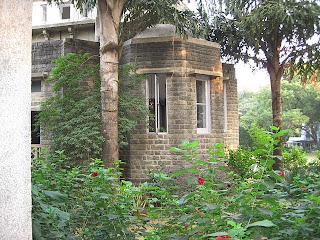
view of the chapel and the pond in the middle of the garden in front of it
another view of the chapel
It sounds like there are many things going on here during the Lenten season, and I am sorry to miss them - talks, extra worship services, liturgy, communion, etc. Church services here are an interesting mix of the liturgy I grew to love during my time attending Anglican communion services in Vancouver, Western praise songs new and old ("There is a Redeemer," "In Christ Alone"), Western traditional hymns, and songs I've never heard before and hope are of Indian Christian origin. So it's been a fun mixture of new, old and familiar, and old yet changed in some way (e.g. new words to a familiar tune). I am grateful it's the same God we worship no matter the place, language, or culture.
patient snapshots
I wanted to share a couple of patient stories that have particularly struck/moved me in my time here so far.
The first patient made me cry. A mother and her parents had brought in an 8-month-old baby girl with jaundice. Through the grandfather's explanation and a few questions to my resident, I figured out that she had been brought in six or seven months earlier for jaundice, found to have biliary atresia, and undergone a Kasai procedure to allow the bile to drain from her liver. This had since failed and since liver transplantation was not an option, the goals of care at this point were palliative at best.
The grandfather told me that the itching (from hyperbilirubinemia - high bilirubin levels in the blood) was keeping her up at night crying. Her bilirubin had gone from 17 at the last visit to 19 and her alk phos from already elevated in the 100s to high 200s (a sign of obstruction). Upon reiteration of the no-more-options place we had reached in treatment, tears welled up in the mother's eyes. The grandmother took the crying, fitful baby and walked away, wiping her own eyes. I patted the mother's shoulder helplessly and found a tissue in my purse to offer. Eventually we led the patient's family to an empty room to allow them to talk and cry, and I left the room crying myself.
A second patient that moved me was a child I saw during my time on pediatrics when I went to ID clinic where they see HIV-positive patients. I am sure I will see many more HIV-positive patients and AIDS patients in zambia, but I haven't seen any others here. It was my first time seeing pediatric HIV patients, many of whom were infected in utero by moms who found out they were positive when tested during pregnancy. Seeing one family come in - mother, father, and five-year-old daughter - all HIV-positive felt like such a death sentence. There are not many antiretroviral regimens available here, and compliance is often a problem due to finance, leading to the possibility of resistance.
The first patient made me cry. A mother and her parents had brought in an 8-month-old baby girl with jaundice. Through the grandfather's explanation and a few questions to my resident, I figured out that she had been brought in six or seven months earlier for jaundice, found to have biliary atresia, and undergone a Kasai procedure to allow the bile to drain from her liver. This had since failed and since liver transplantation was not an option, the goals of care at this point were palliative at best.
The grandfather told me that the itching (from hyperbilirubinemia - high bilirubin levels in the blood) was keeping her up at night crying. Her bilirubin had gone from 17 at the last visit to 19 and her alk phos from already elevated in the 100s to high 200s (a sign of obstruction). Upon reiteration of the no-more-options place we had reached in treatment, tears welled up in the mother's eyes. The grandmother took the crying, fitful baby and walked away, wiping her own eyes. I patted the mother's shoulder helplessly and found a tissue in my purse to offer. Eventually we led the patient's family to an empty room to allow them to talk and cry, and I left the room crying myself.
A second patient that moved me was a child I saw during my time on pediatrics when I went to ID clinic where they see HIV-positive patients. I am sure I will see many more HIV-positive patients and AIDS patients in zambia, but I haven't seen any others here. It was my first time seeing pediatric HIV patients, many of whom were infected in utero by moms who found out they were positive when tested during pregnancy. Seeing one family come in - mother, father, and five-year-old daughter - all HIV-positive felt like such a death sentence. There are not many antiretroviral regimens available here, and compliance is often a problem due to finance, leading to the possibility of resistance.
Yet at the same time I was moved with a small portion of God's love for them in the midst of their difficult life circumstances. Jesus loves you, little one, was all I could think with regards to the little girl. Jesus loves you, I thought to the parents who didn't have any easy answers.
And neither do I. But I do have a deep conviction that God walks with them - and with the family of the baby with jaundice - in their situation in love as much as he moves in my privileged life with the same love. Left speechless to communicate any of this by my lack of Tamil, I simply prayed that they would come to know the love of the Father who one day will heal all our diseases and wipe away every tear.
Saturday, February 20, 2010
update 3
I've spent the last week and will spend next week's three days of work at the Low-Cost Effective Care Unit (LCECU). It is a primary care office/small hospital run by family medicine doctors who are committed to serve the poor people of Vellore who could not afford to go to the main hospital of Christian Medical College (CMC). They do some minor procedures as well - toe amputations, pleurocentesis, wound debridement, lymph node biopsy, etc.
I spoke with one of the attendings early in the week about my desire to do medical mission work, and he explained that working here was much like that for him since he speaks another primary language (he's from a neighboring state) and in many ways this is cross-cultural for him. He said that there are many benefits to working with the poor, however: you never feel like you have to up your standard of living to match that of your patients. They are generally very grateful for help. You have the personal satisfaction of doing something good. But we agreed together that it would be difficult to do cross-cultural service on a long-term basis without some sense of calling from and sustenance by God.
Specialists also come into LCECU once a week or so (orthopedics, gastroenterology, psychiatry, etc.) to offer their service to patients at a lower cost than at the main hospital. I got to work with the psychiatrist on Friday and saw in the space of a few hours two psychotic patients, three bipolar patients, one woman with panic attacks, two wives of alcoholics who beat them when they are drunk and spend all the money the family has, leaving them starving, a very depressed woman who cried and cried, a schizophrenic, a person with obsessive-compulsive disorder and hypochondriac, anxiety disorder, depression with temporal lobe epilepsy, depression and anxiety with somatization. It was very interesting (imipramine is very common for depression here since it's cheap, and risperidone for agitation or as an antipsychotic) as well as a bit emotionally wearing.
The psychiatrist explained to me that the alcoholics can take a very small dose of an antipsychotic to curb aggressive behavior when they are drunk. One of the wives cannot afford even the subsidized prescription, which costs Rs. 20 (about 45 cents) for a week, so her husband has been beating up everyone in the house. The psychiatrist explained that social services for domestic violence are nearly non-existent here and "Wives are considered part of their husband's household when they marry. Therefore, their families often tell them to live with or die with their husband if they try to return home. And they do," she said. For want of 20 rupees a week to curb aggression when drunk. My heart both cries for justice and mercy and feels unable to grasp these women's circumstances and their lives. "I don't know how these women go on," the psychiatrist commented several times in the afternoon. I don't either.
I spoke with one of the attendings early in the week about my desire to do medical mission work, and he explained that working here was much like that for him since he speaks another primary language (he's from a neighboring state) and in many ways this is cross-cultural for him. He said that there are many benefits to working with the poor, however: you never feel like you have to up your standard of living to match that of your patients. They are generally very grateful for help. You have the personal satisfaction of doing something good. But we agreed together that it would be difficult to do cross-cultural service on a long-term basis without some sense of calling from and sustenance by God.
Specialists also come into LCECU once a week or so (orthopedics, gastroenterology, psychiatry, etc.) to offer their service to patients at a lower cost than at the main hospital. I got to work with the psychiatrist on Friday and saw in the space of a few hours two psychotic patients, three bipolar patients, one woman with panic attacks, two wives of alcoholics who beat them when they are drunk and spend all the money the family has, leaving them starving, a very depressed woman who cried and cried, a schizophrenic, a person with obsessive-compulsive disorder and hypochondriac, anxiety disorder, depression with temporal lobe epilepsy, depression and anxiety with somatization. It was very interesting (imipramine is very common for depression here since it's cheap, and risperidone for agitation or as an antipsychotic) as well as a bit emotionally wearing.
The psychiatrist explained to me that the alcoholics can take a very small dose of an antipsychotic to curb aggressive behavior when they are drunk. One of the wives cannot afford even the subsidized prescription, which costs Rs. 20 (about 45 cents) for a week, so her husband has been beating up everyone in the house. The psychiatrist explained that social services for domestic violence are nearly non-existent here and "Wives are considered part of their husband's household when they marry. Therefore, their families often tell them to live with or die with their husband if they try to return home. And they do," she said. For want of 20 rupees a week to curb aggression when drunk. My heart both cries for justice and mercy and feels unable to grasp these women's circumstances and their lives. "I don't know how these women go on," the psychiatrist commented several times in the afternoon. I don't either.
Subscribe to:
Posts (Atom)